Lyrics
Les paroles complètes de « Au Clair de la Lune » avec traduction en anglais.
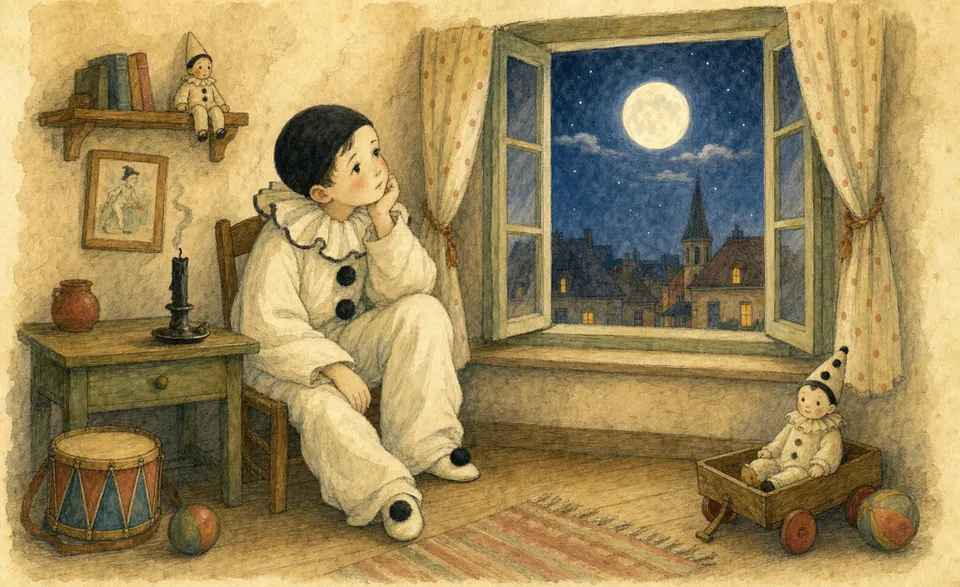
Au clair de la lune, Mon ami Pierrot, Prête-moi ta plume Pour écrire un mot. Ma chandelle est morte, Je n'ai plus de feu. Ouvre-moi ta porte Pour l'amour de Dieu.
#English translation
By the light of the moon, my friend Pierrot, lend me your pen to write a word. My candle is dead, I have no more fire. Open your door to me for the love of God.
#Au Clair de la Lune at a glance
- Country of origin
- 🇫🇷 France
- Sung in
- French
- Words by
- Traditional
- First known
- 18th century (in print 1820)
- Best for ages
- 2–7
- Mood
- lullaby, traditional
- Last updated
- 25 July 2026
Meaning and origin
Few nursery songs carry a secret this remarkable. “Au clair de la lune” is an ordinary-seeming 18th-century French folk song — a moonlit little scene in which the singer knocks at the door of a friend called Pierrot, asking to borrow a pen because their candle has gone out and they have no fire to relight it. No one knows who wrote it; it simply appeared in print in 1820 and has been sung ever since, often slowly, as a lullaby.
Its fame rests on a single extraordinary fact. On 9 April 1860 — seventeen years before Edison built his phonograph — the Frenchman Édouard-Léon Scott de Martinville recorded someone singing its opening bars onto a soot-blackened sheet with a device called a phonautograph. He could not play it back; he was only tracing sound as a squiggle. But in 2008 researchers converted that squiggle into audible sound, and so a scrap of this children’s song became the earliest recognisable recording of a human voice in history.
There is even a scholarly footnote hidden in the words. Some believe the line prête-moi ta plume (“lend me your pen”) was once prête-moi ta lume — using an old word for light or lamp — which fits the song’s theme of a lost flame far better. Whether pen or light, it is a small, tender thing: a request to a neighbour on a dark night, which the world happened to preserve forever.
Common questions
- What is "Au clair de la lune" about?
- A small night-time scene. By the light of the moon, the singer calls on a friend named Pierrot: lend me your pen to write a word, my candle has gone out and I have no fire, so open your door for the love of God. It is gentle and a little melancholy, and is often sung as a lullaby.
- How old is "Au Clair de la Lune", and who wrote it?
- It is a French folk song of the 18th century whose composer and lyricist are unknown. It first appeared in print in 1820, and a fuller four-verse version was published in 1858.
- Why is "Au Clair de la Lune" historically important?
- Because of a recording. On 9 April 1860, Édouard-Léon Scott de Martinville captured someone singing its opening line on his "phonautograph" — the earliest recognisable recording of the human voice, made 17 years before Edison's phonograph. The trace was turned back into playable sound in 2008.