Lyrics
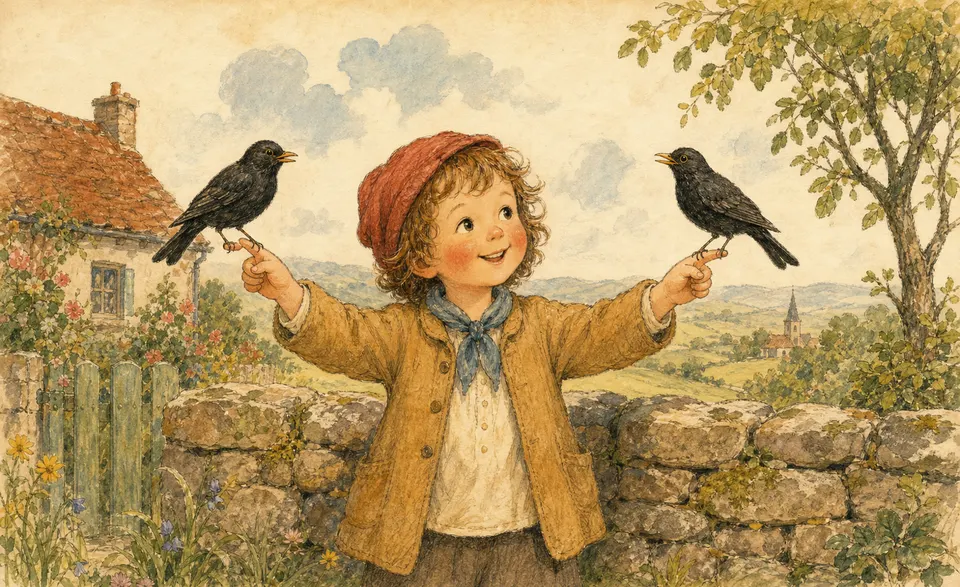
Two little blackbirds sitting on a wall, One named Peter, The other named Paul.
#Fly away, Peter! Fly away, Paul! Come back, Peter! Come back, Paul!
#Two Little Blackbirds at a glance
- Country of origin
- 🇬🇧 United Kingdom
- Sung in
- English
- Words by
- Traditional
- First known
- first recorded c. 1765
- Best for ages
- 2–7
- Mood
- playful, traditional
- Last updated
- 27 August 2026
How to sing it
- Hold up two index fingers as the two birds sitting on the wall.
- On "fly away", send each finger up and behind your back in turn.
- On "come back", bring each finger back to the wall — the delight is in the return.
Meaning and origin
This is one of the gentlest of all fingerplays, and one of the oldest. Two little birds — Peter and Paul — sit on a wall, represented by a child’s two raised index fingers. One at a time they fly away, each finger vanishing behind the back, and then, to the small performer’s delight, each comes back again. Like peekaboo, its entire magic is the safe return: things disappear, but they always come home.
The rhyme has been in books since about 1765, when it appeared in Mother Goose’s Melody — though it looked a little different then. Originally the birds were named Jack and Gill and sat on a hill; only in the 19th century did they become Peter and Paul (after the two apostles) perched on a wall. It travels under two names: British children often meet it as “Two Little Dickie Birds”, while “Two Little Blackbirds” is the more familiar American form. Whatever they are called, the pleasure is the same — a first, reassuring lesson that what flies away can be called back.
Common questions
- How do you play "Two Little Blackbirds"?
- As a fingerplay. Your two index fingers are the birds, Peter and Paul, perched on a wall. One at a time they "fly away" — the finger disappears behind your back — and then, to a child's great satisfaction, they "come back" again. It is a tiny game of disappearance and return, like peekaboo.
- How old is "Two Little Blackbirds", and why Peter and Paul?
- It was first recorded around 1765, in "Mother Goose's Melody". In the earliest version the birds were named Jack and Gill and sat on a hill; the names were changed to Peter and Paul (after the apostles), on a wall, in the 19th century.
- Why is it called "Two Little Blackbirds" sometimes and "dickie birds" other times?
- They are the same rhyme. "Two Little Dickie Birds" is the British name ("dickie bird" is affectionate slang for a little bird), while "Two Little Blackbirds" is the more common American form. Neither is the older wording: the c. 1765 text in Mother Goose's Melody already read "two blackbirds".