Lyrics
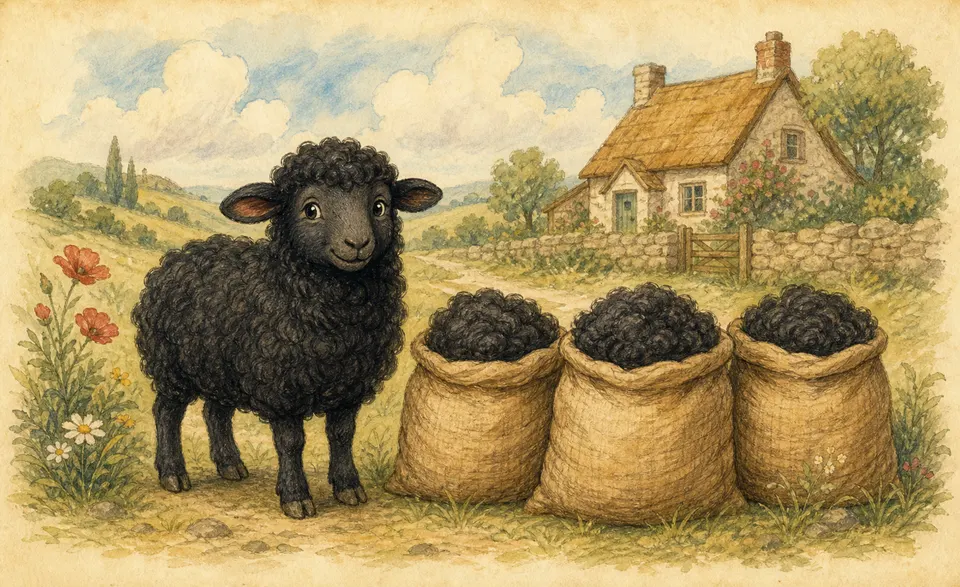
Baa, baa, black sheep, have you any wool? Yes, sir, yes, sir, three bags full. One for my master, one for my dame, And one for the little boy who lives down the lane. Baa, baa, black sheep, have you any wool? Yes, sir, yes, sir, three bags full.
#Baa, Baa, Black Sheep at a glance
- Country of origin
- 🇬🇧 United Kingdom
- Sung in
- English
- Words by
- Traditional
- First known
- c. 1744
- Best for ages
- 2–7
- Mood
- playful, traditional
- Last updated
- 25 July 2026
Meaning and origin
This is one of the very oldest nursery rhymes still sung, and one of the plainest: a question, an answer, and an accounting of who gets the wool. It has been in print since about 1744, when it appeared in Tommy Thumb’s Pretty Song Book in almost exactly the words children use today — a rare thing, since most rhymes drift over the centuries.
Part of why it feels so familiar is that you already know the tune. The melody is a version of the French air “Ah! vous dirai-je, maman”, the same one that carries “Twinkle, Twinkle, Little Star” and the alphabet song; a child can slide from one to another without noticing. The words and this melody were first printed together in 1879.
Like many old rhymes, it has attracted grand explanations — that it encodes a medieval tax on wool, or, later, the slave trade. Neither has any historical support, and the wool-tax idea only dates from 1930. The likeliest truth is the dullest: it is a small song about a sheep and three bags of wool, shared out between a master, a dame, and a boy down the lane.
Common questions
- How old is "Baa, Baa, Black Sheep"?
- It first appears in print around 1744, in "Tommy Thumb's Pretty Song Book", with wording very close to the version sung today — which makes it one of the oldest English nursery rhymes still in common use.
- Why does "Baa, Baa, Black Sheep" sound like "Twinkle, Twinkle, Little Star"?
- Because it is the same tune. The melody is a variant of the 18th-century French air "Ah! vous dirai-je, maman", which also carries "Twinkle, Twinkle, Little Star" and the alphabet song. Those words and this melody were first printed together in 1879.
- Is the rhyme really about a medieval wool tax?
- There is no evidence for it. The idea was suggested in 1930, and a later claim tied the rhyme to the slave trade, but historians have found nothing to support either reading. The rhyme is most simply about a sheep, its wool, and who gets a share of it.
- Why a black sheep?
- One practical explanation is that black wool was valued because it could be made into dark cloth without dyeing. Beyond that, the rhyme is a plain little exchange — a question, an answer, and three bags full.