Lyrics
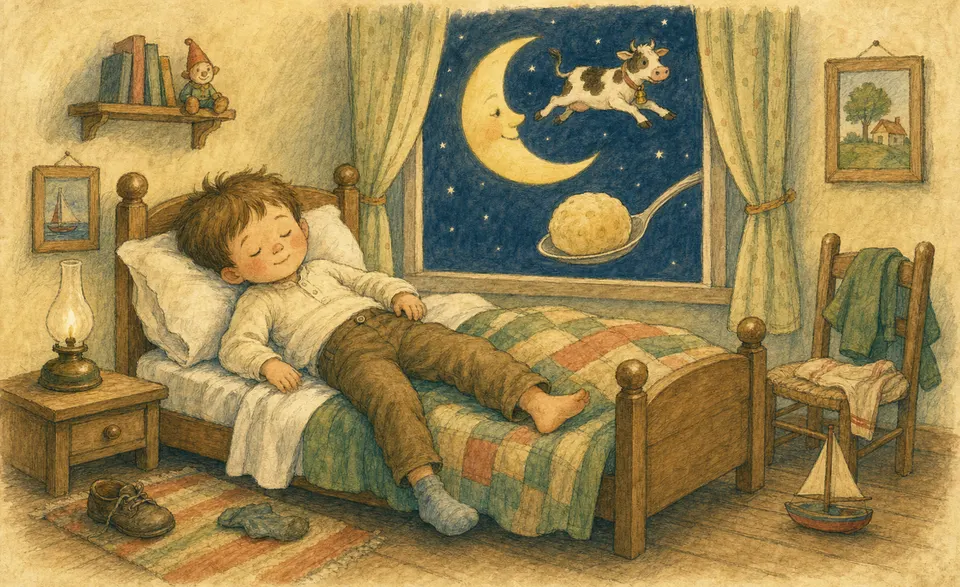
Diddle diddle dumpling, my son John Went to bed with his britches on. One shoe off, and one shoe on; Diddle diddle dumpling, my son John.
#Diddle Diddle Dumpling at a glance
- Country of origin
- 🇬🇧 United Kingdom
- Sung in
- English
- Words by
- Traditional
- First known
- first recorded c. 1797
- Best for ages
- 2–7
- Mood
- playful, traditional
- Last updated
- 27 August 2026
Meaning and origin
This is one of the smallest and most affectionate of the old English nursery rhymes — a single snapshot of a child too sleepy to undress. “My son John” tumbles into bed with his breeches still on and only one shoe removed, and the rhyme lingers fondly on that lopsided detail: one shoe off, and one shoe on. Any parent who has ever found a child asleep half-dressed will recognise it instantly.
It is genuinely old, first recorded around 1797 in a London collection called The Newest Christmas Box. The odd opening, diddle diddle dumpling, may be borrowed from real life: hot-dumpling sellers once cried those very words through the streets, and the rhyme seems to have grown up alongside that call, though no one can say for certain which came first. Either way, the nonsense syllables do what nonsense does best — they give the tongue something to enjoy while the picture of drowsy John does the rest.
Common questions
- What is the rhyme about?
- A boy too sleepy (or too silly) to undress properly. "My son John" goes to bed with his trousers still on and just one shoe off — one shoe off and one shoe on — a small, funny picture of a child flopping into bed half-dressed.
- How old is "Diddle Diddle Dumpling"?
- It is first recorded in "The Newest Christmas Box", published in London around 1797, which makes it a little over two centuries old in print. It carries the Roud Folk Song Index number 19709.
- What does "diddle diddle dumpling" mean?
- It may come from a street cry. Sellers of hot dumplings once called out "diddle, diddle, dumpling" through the streets, and the rhyme may have grown from that — though it is unclear whether the cry or the rhyme came first.