Lyrics
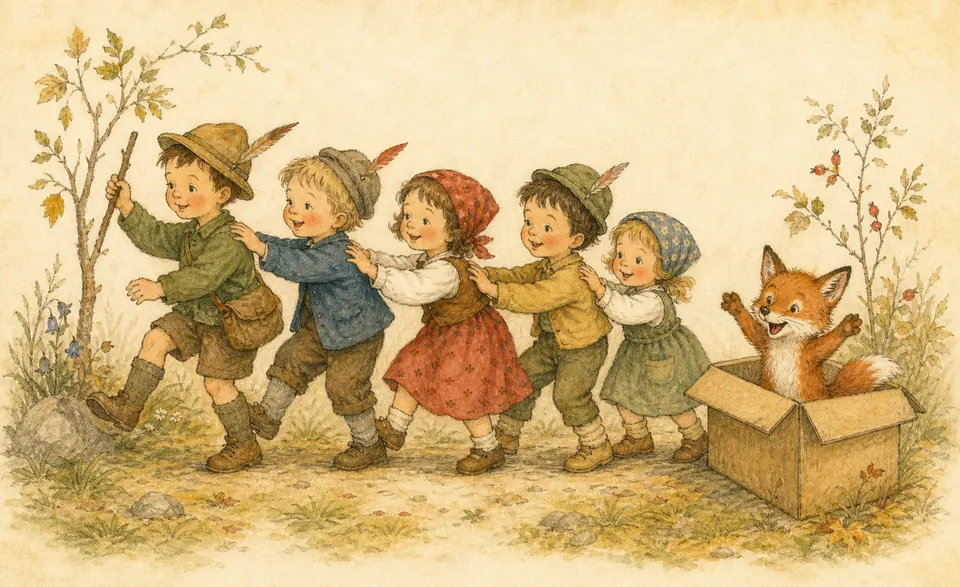
A hunting we will go, a hunting we will go, Heigh ho, the dairy-o, a hunting we will go. A hunting we will go, a hunting we will go, We'll catch a fox and put him in a box And then we'll let him go.
#A-Hunting We Will Go at a glance
- Country of origin
- 🇬🇧 United Kingdom
- Sung in
- English
- Words by
- Traditional
- First known
- tune by Thomas Arne, 1777; the words have no recorded author
- Best for ages
- 2–7
- Mood
- playful, traditional
- Last updated
- 27 August 2026
How to sing it
- Act out catching the fox and popping him into a box on the matching lines.
- On "and then we'll let him go", open your hands and set the fox free — no harm done.
- Make up further verses on the same pattern; printed versions add a fish put on a dish, and other animals that rhyme.
Meaning and origin
This is a song about a hunt in which nothing gets hurt. The singers set off “a-hunting”, catch a fox, put him in a box — and then, in the last line, let him go again. That gentle ending is the whole character of the children’s version: it is not really about hunting at all, but about the pleasure of the rhyme and the little story that resets itself every verse, ready for another animal.
The words have no recorded author, but the tune does: Wikipedia’s account is that Thomas Arne composed it in 1777 for a London production of The Beggar’s Opera. It has since travelled well beyond the nursery — it is also the tune of the English football chant “Ee Aye Addio”. The song’s neat, repeating shape makes it a favourite frame for invention: printed versions go on to catch a fish and put him on a dish, and once children have the pattern they will happily go hunting for anything else that rhymes with a good hiding place.
Common questions
- What is "A-Hunting We Will Go" about?
- A cheerful pretend hunt. The singers set off "a-hunting", catch a fox, put him in a box — and then let him go again. In the children's version no animal is harmed; the fun is in the rhyme, not the chase.
- How old is "A-Hunting We Will Go", and who wrote the tune?
- The tune was composed by Thomas Arne in 1777, for a London production of "The Beggar's Opera"; the words have no recorded author. The same tune is also used for the English football chant "Ee Aye Addio".
- Are there more verses to "A-Hunting We Will Go"?
- Yes. Printed versions continue the pattern with other animals — "we'll catch a fish and put him on a dish, and then we'll let him go" — and the short, repeating shape makes it easy to invent new ones.