Lyrics
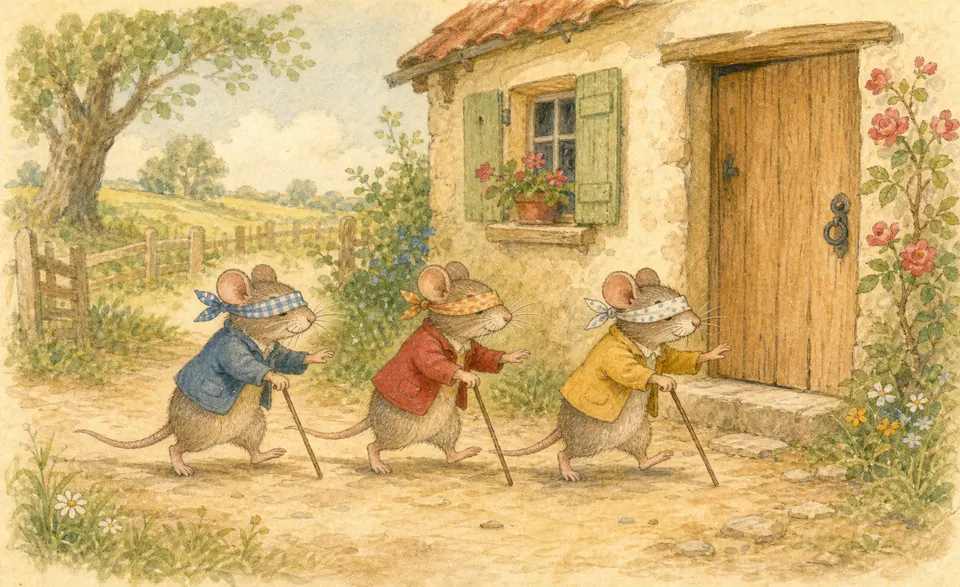
Three blind mice, three blind mice, See how they run, see how they run! They all ran after the farmer's wife, Who cut off their tails with a carving knife, Did you ever see such a sight in your life, As three blind mice?
#Three Blind Mice at a glance
- Country of origin
- 🇬🇧 United Kingdom
- Sung in
- English
- Words by
- Traditional
- First known
- 1609
- Best for ages
- 2–7
- Mood
- playful, traditional
- Last updated
- 25 July 2026
How to sing it
- Learn the short tune first — it is built to be sung as a round.
- Split into groups and start each one a line behind the last, so the parts overlap.
- Run your fingers along in time with "see how they run" to keep everyone together.
Meaning and origin
This little song is older than almost anything else in the nursery. A version of it was printed in 1609, in a music book by Thomas Ravenscroft, which makes “Three Blind Mice” one of the very oldest printed songs that children still sing. The early words were not quite ours — they mention a “Dame Julian” rather than a farmer’s wife — but the mice were already there, and already running.
It was written as a round: sung by several groups starting one after another, so the tune chases itself into harmony, the mice forever running after one another as the voices do. That built-in overlap is why it has lasted as a group song and not just a rhyme.
Its faintly gruesome ending has, predictably, attracted a grand theory: that the three mice are three Protestant bishops put to death under Queen Mary I. It does not survive a second look — those bishops were burned rather than blinded, the oldest version of the song does no harm to the mice at all, and the printing comes well after Mary’s time. What endures is simpler and stranger: three blind mice, a carving knife, and four hundred years of children delighting in it.
Common questions
- How old is "Three Blind Mice"?
- Very old. A version was printed in 1609, in Thomas Ravenscroft's music collection "Deuteromelia", which makes it one of the oldest printed songs still sung by children. The early words were a little different, mentioning a "Dame Julian" rather than the farmer's wife.
- Is it about Queen Mary I and three bishops?
- That is a popular theory — that the "three blind mice" are three Protestant bishops executed under Mary I. But it does not hold up: the bishops were burned, not blinded, the earliest version does not harm the mice at all, and the rhyme was printed long after Mary's reign.
- What is a round?
- A song where several groups sing the same tune starting at different times, so the parts overlap into harmony — like "Frère Jacques" or "Row, Row, Row Your Boat". "Three Blind Mice" was written as one.