LyricsHistorical print version (Brooke, 1922)
Ring a ring o’ roses, A pocket full of posies; Hush! hush! hush! And we all tumble down.
#LyricsModern UK classroom version
Ring-a-ring-a-roses, A pocket full of posies, A-tishoo! A-tishoo! We all fall down. Fishes in the water, Fishes in the sea, We all jump up With a one, two, three! Ring-a-ring-a-roses, A pocket full of posies, A-tishoo! A-tishoo! We all fall down.
#Ring a Ring o’ Roses at a glance
- Country of origin
- 🇬🇧 United Kingdom
- Sung in
- English
- Words by
- Traditional
- First known
- 1881 (earliest English printing traced by the Library of Congress)
- Best for ages
- 2–7
- Mood
- dancing, traditional, playful
- Last updated
- 22 August 2026
How to sing it
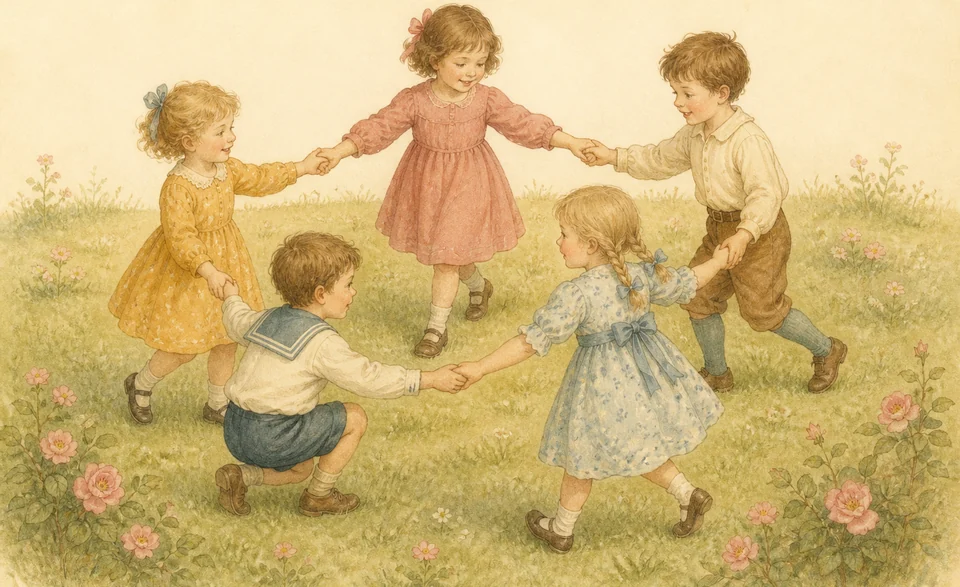
- Form a circle, hold hands, and walk steadily around while singing the roses stanza.
- On “we all fall down”, crouch together instead of pulling anyone to the floor; during the fishes verse, make swimming motions while staying low.
- Count “one, two, three”, jump up together, and use the repeated roses stanza to finish the classroom sequence.
Meaning and origin
“Ring a Ring o’ Roses” belongs to the ring-game tradition: children join hands, move in a circle, and drop together on the final cue. Its words have never been fixed. Alice Gomme’s 1898 survey records multiple forms and different final actions, showing a rhyme shaped by play rather than by a single author.
The historical panel comes from L. Leslie Brooke’s picture book Ring O’ Roses, published by Frederick Warne; the Gutenberg transcription’s title page carries no date, and the 1922 comes from the Internet Archive’s library catalogue record. It is presented as one documented print version, not as the original. The Library of Congress traces English print evidence to 1881 and notes that related Continental games are older.
The modern panel preserves the classroom sequence supplied for this song. Its first two sections — the familiar “a-tishoo” stanza followed by “fishes in the water” and a jump on three — match the version published by the National Literacy Trust’s Words for Life programme. The supplied sequence then repeats the roses stanza as a closing round.
The familiar claim that the rhyme secretly describes plague is much later than the rhyme’s first documentation. Folklorists reject it because the explanation appears only in the mid-twentieth century and because older variants do not consistently contain the supposed disease symbols.
Common questions
- Is “Ring a Ring o’ Roses” about the plague?
- No reliable early evidence connects the rhyme with plague. The Library of Congress notes that the plague explanation appeared only in the mid-twentieth century and does not fit the many older variants.
- Why are there two lyric versions on this page?
- There is no single original text. The first panel preserves L. Leslie Brooke’s 1922 print stanza; the second gives the supplied modern classroom sequence, whose roses-and-fishes core is also published by the National Literacy Trust’s Words for Life programme.
- What do children do during the modern “fishes” verse?
- After crouching on “we all fall down”, children can mime swimming for the fishes lines, count together, and jump back up on “three”. The final roses stanza repeats the circle game to close the supplied sequence.
Sources
- Library of Congress — Ring Around the Rosie: Metafolklore, Rhyme and Reason
- A. B. Gomme, The Traditional Games of England, Scotland, and Ireland, vol. II (1898)
- L. Leslie Brooke, Ring O’ Roses (Project Gutenberg transcription; title page undated)
- L. Leslie Brooke, Ring O’ Roses — Internet Archive copy, catalogued as F. Warne, London and New York, [1922]
- National Literacy Trust, Words for Life — Ring-a-ring o’ roses