Lyrics
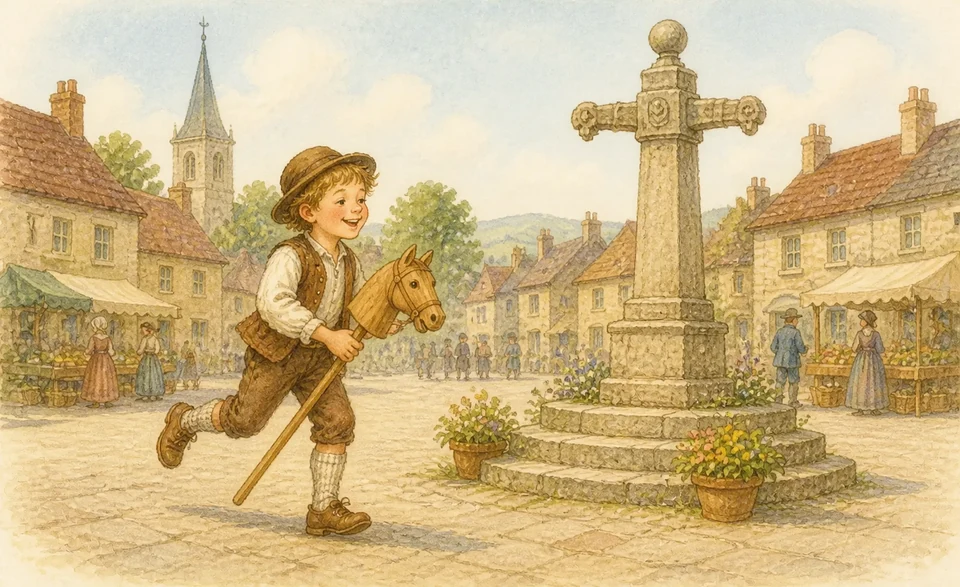
Ride a cock horse to Banbury Cross, To see a fine lady upon a white horse; Rings on her fingers and bells on her toes, She shall have music wherever she goes.
#Ride a Cock Horse to Banbury Cross at a glance
- Country of origin
- 🇬🇧 United Kingdom
- Sung in
- English
- Words by
- Traditional
- First known
- 1784 (old-woman form); fine-lady form in the early collection Infant Institutes, undated in the retrieved note
- Best for ages
- 1–5
- Mood
- playful, traditional
- Last updated
- 27 August 2026
How to sing it
- Begin slowly so everyone can hear the repeated words and the action cue.
- Bounce a seated child gently on a knee, pause at Banbury Cross, and jingle fingers and toes on the last two lines.
- Repeat the song once and invite a different child to lead the cues.
Meaning and origin
The rhyme turns a short ride into a bright procession. A child travels to Banbury Cross to see a rider on a white horse, with rings on her fingers and bells on her toes. “Cock-horse” can mean a rocking horse, and the verse is also widely suited to knee bouncing: the adult’s knee becomes the pretend horse while the final bells are shown with jingling fingers and feet.
The rider has not always been the same. The note from the Opies’ collection excerpted in the Warburg Institute archive says early versions “do not agree in their descriptions of the lady”: she is an old woman in 1784 and, around 1790, “the strangest old woman that ever you saw” with a ring on her finger and a bonnet of straw; the early collection Infant Institutes is the one that opens with a fine lady, while Songs for the Nursery puts an old woman on a black horse. The same note lists the identities popular tradition has offered — Queen Elizabeth, Lady Godiva, the horsewoman Celia Fiennes — and calls the question “most difficult”. None of the retrieved sources proves that the fine lady represents one historical person. The page therefore treats the changing rider as part of the rhyme’s print history rather than choosing a speculative identity.
For a lap game, seat the child securely, bounce gently in time and pause at Banbury Cross before the final two lines. Fingers can make the rings sparkle and toes can shake like bells. The movement should stay small and supported, especially with a very young child; the pleasure comes from the expected pause and jingle, not from a hard gallop.
Common questions
- What is a cock-horse in Ride a Cock Horse to Banbury Cross?
- A cock-horse can mean a rocking horse. The rhyme is also commonly performed as a knee bounce, with the adult’s knee serving as the child’s pretend horse.
- Who was the fine lady at Banbury Cross?
- No historical identity has been proved. The Opies’ note, as excerpted in the Warburg Institute archive, records an old woman in 1784 and again around 1790, a fine lady in the early collection Infant Institutes, and an old woman on a black horse in Songs for the Nursery; the guesses it lists — Queen Elizabeth, Lady Godiva, Celia Fiennes — are popular tradition, not evidence. The rhyme does not support one definitive person.