Lyrics
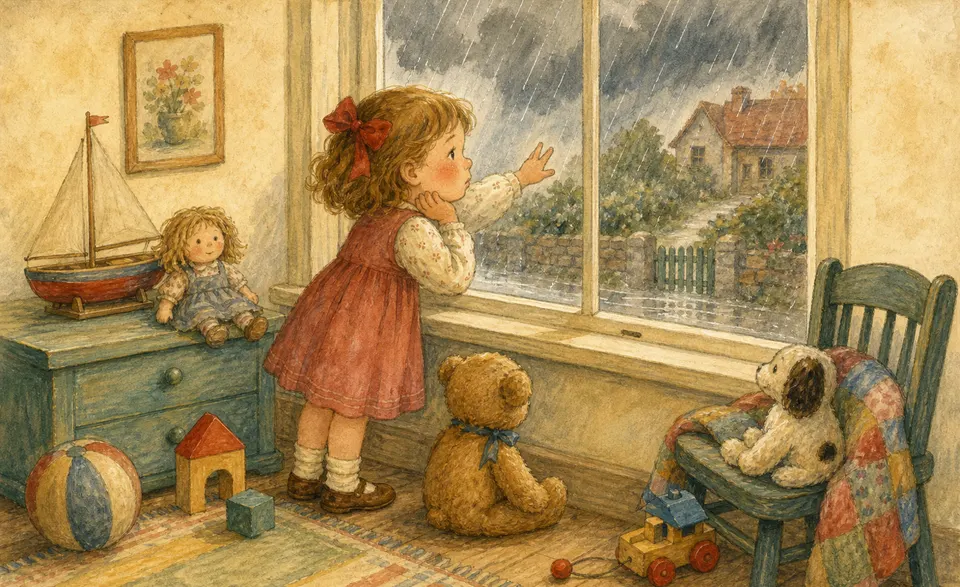
Rain, rain, go away, Come again another day. Rain, rain, go away, Little Bobby wants to play.
#Rain, Rain, Go Away at a glance
- Country of origin
- 🇬🇧 United Kingdom
- Sung in
- English
- Words by
- Traditional
- First known
- 17th century (recorded 1659)
- Best for ages
- 2–7
- Mood
- playful, traditional
- Last updated
- 25 July 2026
Meaning and origin
This is one of the oldest things in the whole nursery, and one of the simplest: a charm against the rain. When the weather keeps children indoors, they chant at it, politely asking it to leave and come back some other day — and the last line is always adjusted to name whoever is longing to get outside, so it becomes “little Bobby wants to play”, or your own name in its place.
It is genuinely ancient. As far back as 1659 the writer James Howell recorded a version — “Raine, raine, goe to Spain: faire weather come againe” — and around the same time John Aubrey noticed that children had a habit of singing “to charme away the Raine”. Rhymes like this are older still: the Greeks and Romans had their own chants at the weather.
That is really what it is — not a story but a small ritual, a wish said out loud. It survives because it is useful in the only way a child needs: it gives you something to do while you wait for the sky to clear, and it lets you put your own name at the end.
Common questions
- How old is "Rain, Rain, Go Away"?
- At least three and a half centuries. James Howell recorded an early form — "Raine, raine, goe to Spain: faire weather come againe" — in a collection of proverbs in 1659, and around the same time John Aubrey noted that children had "a custom when it raines to sing or charme away the Raine".
- What kind of rhyme is "Rain, Rain, Go Away"?
- A weather-charm: a little chant meant to make the rain stop. Children have always changed the last line to name whoever wants to go out — "little Bobby wants to play", or their own name — which is part of why it survives so easily.
- Are there other versions?
- Many. Regional forms were collected all over Britain and North America, each with its own ending about when the rain should come back. Charms like this are ancient — the Greeks and Romans had rain-rhymes too — so the little song belongs to a very old habit of singing at the weather.