Lyrics
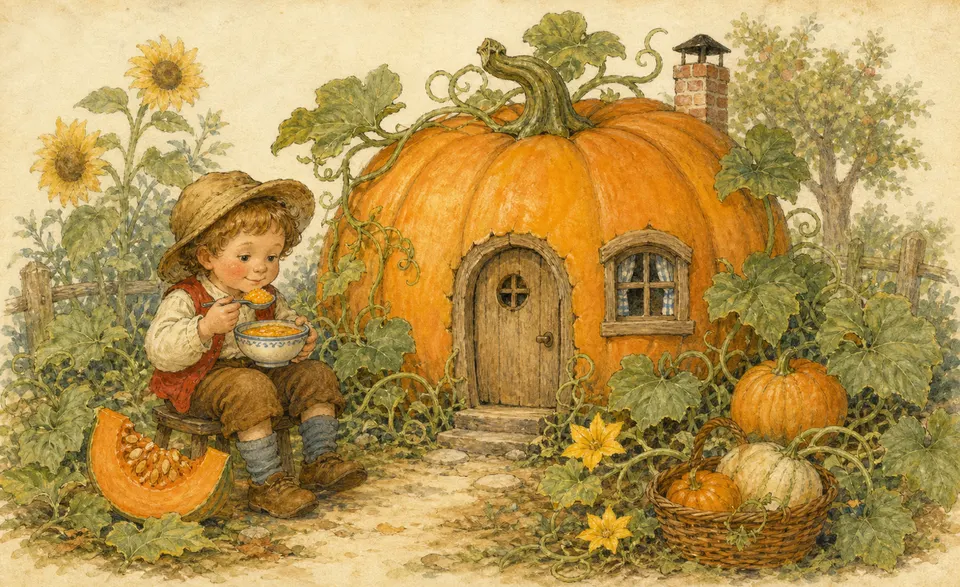
Peter, Peter pumpkin eater, Had a wife and couldn't keep her! He put her in a pumpkin shell, And there he kept her very well!
#Peter Peter Pumpkin Eater at a glance
- Country of origin
- 🇬🇧 United Kingdom
- Sung in
- English
- Words by
- Traditional
- First known
- c. 1797
- Best for ages
- 2–7
- Mood
- playful, traditional
- Last updated
- 25 July 2026
Meaning and origin
This is one of the odder little rhymes children happily sing without a second thought: a man who cannot “keep” his wife solves the problem by housing her inside a pumpkin, and — the verse insists, quite pleased with itself — keeps her “very well”. It is nonsense with a faintly surreal edge, the kind of image that sticks precisely because it makes no sense.
It has roots on both sides of the Atlantic. The earliest surviving version is a British one, from about 1797, and it was printed in Boston around 1825; an older Scottish cousin of it was collected and published in 1868. That Scottish verse is also counted as a version of another rhyme, “Eeper Weeper”, which plays with the same strange theme of a husband and a wife who will not stay put.
No convincing meaning has ever been pinned to it, and it probably never had one. What it offers is a single vivid picture — a giant pumpkin turned into a little house — and a child’s delight in something just impossible enough to be funny.
Common questions
- How old is "Peter, Peter, Pumpkin Eater"?
- The earliest surviving version is from about 1797, in a London collection called "Infant Institutes". It was printed in Boston around 1825, and an older Scottish variant was collected and published in 1868 — so it has both British and American roots.
- What does the rhyme mean?
- On its face, very little: Peter cannot manage his wife, so he houses her in a hollowed-out pumpkin, where — the rhyme cheerfully insists — he keeps her "very well". Like much nursery verse it is a small absurd picture rather than a story with a moral, and no hidden meaning has been established.
- Is "Peter Peter Pumpkin Eater" related to any other rhyme?
- Yes — the older Scottish verse behind it is also considered a version of the separate rhyme "Eeper Weeper", which shares the same odd theme of a husband and a hard-to-keep wife.