Lyrics
Familiar short game version (composite)
Oranges and lemons, Say the bells of St Clement’s. You owe me five farthings, Say the bells of St Martin’s. When will you pay me? Say the bells at Old Bailey. When I grow rich, Say the bells at Shoreditch. When will that be? Say the bells of Stepney. I’m sure I don’t know, Says the great bell at Bow. Here comes a candle to light you to bed, And here comes a chopper to chop off your head!
#Long bell sequence printed in 1895
Gay go up and gay go down To ring the bells of London Town. Bulls’ eyes and targets, Say the bells of St Margaret’s. Brickbats and tiles, Say the bells of St Giles’. Ha’pence and farthings, Say the bells of St Martin’s. Oranges and lemons, Say the bells of St Clement’s. Pancakes and fritters, Say the bells of St Peter’s. Two sticks and an apple, Say the bells of Whitechapel. Old Father Baldpate, Say the slow bells of Aldgate. Pokers and tongs, Say the bells of St John’s. Kettles and pans, Say the bells of St Anne’s. You owe me ten shillings, Say the bells of St Helen’s. When will you pay me? Say the bells at Old Bailey. When I grow rich, Say the bells at Shoreditch. Pray when will that be? Say the bells of Stepney. I’m sure I don’t know, Says the great bell at Bow. Here comes a candle to light you to bed, And here comes a chopper to chop off your head.
#Oranges and Lemons at a glance
- Country of origin
- 🇬🇧 United Kingdom
- Sung in
- English
- Words by
- Traditional
- First known
- Bell rhyme by about 1744; candle-and-chopper ending printed by 1895; game with the short sequence collected by 1898
- Best for ages
- 3–8
- Mood
- dancing, playful, traditional
- Last updated
- 27 August 2026
How to sing it
- Begin slowly so everyone can hear the repeated words and the action cue.
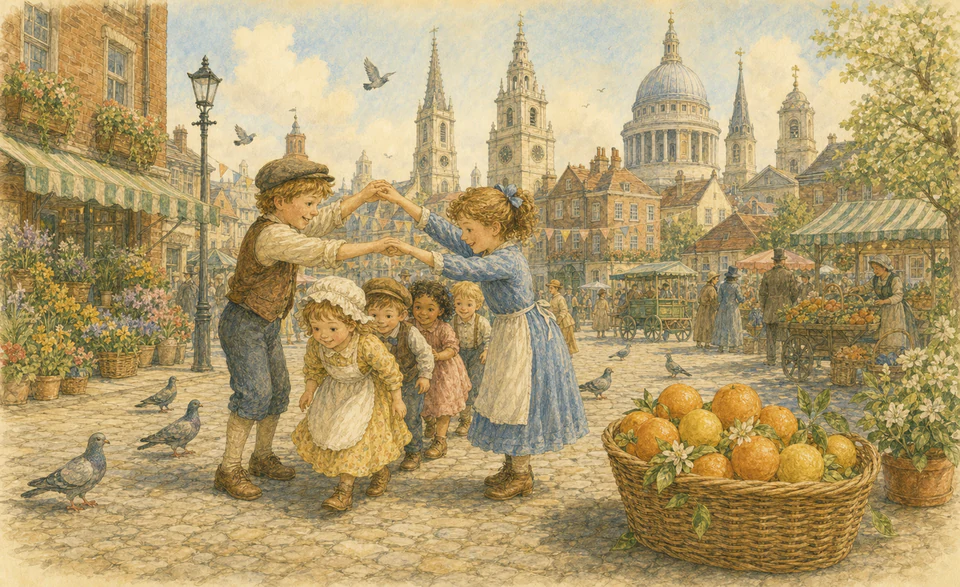
- Two players form an arm arch while the others pass beneath; lower the arch gently on the final “chop off your head,” never onto a child’s neck.
- Repeat the song once and invite a different child to lead the cues.
Meaning and origin
“Oranges and Lemons” imagines London bells speaking to one another. Each pair of lines moves to another church or district and gives its bells a short reply about fruit, money, promises or uncertainty. The geography is real, but the sequence behaves like a chain of remembered voices rather than a street map: St Clement’s, St Martin’s, Old Bailey, Shoreditch, Stepney and Bow lead the familiar shorter form, while longer versions name still more bells.
The 1895 collection used for this page prints a longer list and the ominous candle-and-chopper couplet. Alice Gomme’s 1898 survey of traditional games gives the shorter six-bell sequence as it was sung for the passing game in London and Lincolnshire, with the couplet followed by a chant of “the last, last, last man’s head”; the London Museum’s family page prints the same short sequence with the candle line alone. Because no single retrieved source contains every displayed element in exactly this arrangement, the page labels the text as a composite and keeps the source history visible instead of assigning the whole version one misleading date.
For the game, two players join raised hands to form an arch while the others pass underneath. The arch comes down gently on the final cue to catch one player. The words can also be sung without the catching game; if the arch is used, arms should lower in front of or around the player, never onto a child’s neck.
Common questions
- Which bells are named in Oranges and Lemons?
- The rhyme names bells associated with London churches and districts, including St Clement’s, St Martin’s, Old Bailey, Shoreditch, Stepney and Bow. Longer versions add bells such as St Margaret’s, St Giles’, Whitechapel, Aldgate and St Anne’s.
- Why does Oranges and Lemons end with a candle and a chopper?
- The candle-and-chopper couplet appears in the 1895 printed version and in the game versions Alice Gomme collected in London and Lincolnshire in 1898, where it supplies the dramatic ending for the arch game. Two players lower their joined arms at the final cue to catch one of the players passing underneath — the “last, last, last man’s head” in Gomme’s London text.
Sources
- Wikisource — versions of Oranges and Lemons, including the circa-1744 text
- Wikisource — A Book of Nursery Songs and Rhymes (1895)
- A. B. Gomme, The Traditional Games of England, Scotland, and Ireland, vol. II (1898) — Oranges and Lemons, London and Lincolnshire game versions
- London Museum — Rhymes in Time: Oranges and Lemons