Lyrics
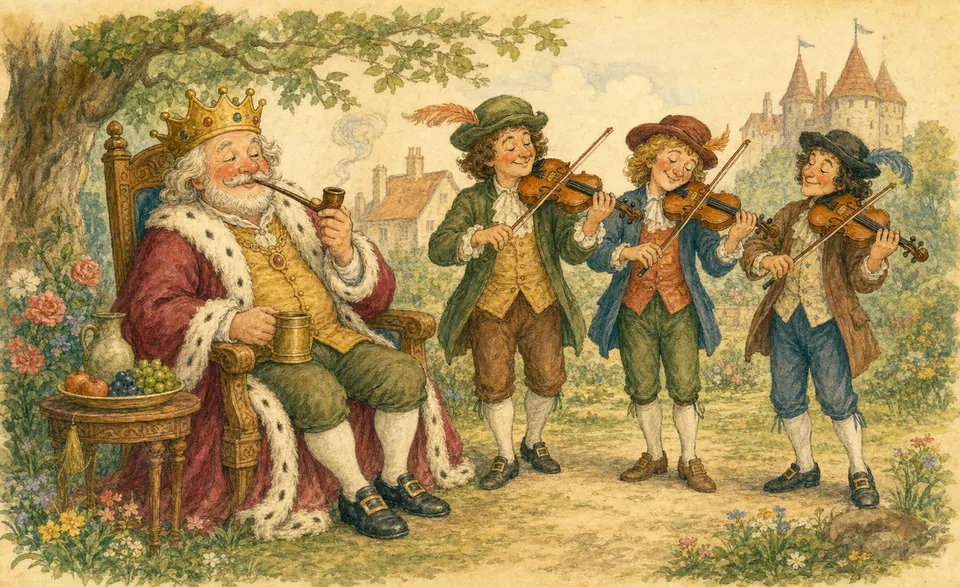
Old King Cole was a merry old soul, And a merry old soul was he; He called for his pipe in the middle of the night, And he called for his fiddlers three.
#Every fiddler had a fine fiddle, And a very fine fiddle had he; Oh there's none so rare as can compare With King Cole and his fiddlers three.
#Old King Cole at a glance
- Country of origin
- 🇬🇧 United Kingdom
- Sung in
- English
- Words by
- Traditional
- First known
- 1709
- Best for ages
- 2–7
- Mood
- playful, traditional
- Last updated
- 27 August 2026
Meaning and origin
Here is a king with no interest in ruling. Old King Cole wants his pipe, his bowl and his fiddlers, and the whole rhyme is really a portrait of good humour — a “merry old soul” who calls for music in the middle of the night and is happy. It is one of those rare rhymes that offer a mood rather than a story, and the mood is contentment.
It was first written down in 1709, and almost at once people began asking who the merry king was. The most tempting candidate is Coel Hen, a legendary early British king whose name really does come out as something like “Old Cole”; others have proposed a cloth merchant from an old story, or a minor Devon gentleman. The scholars’ verdict is honest and a little disappointing: he cannot reliably be matched to any real person.
Which is perhaps as it should be. Old King Cole is less a historical figure than a wish — for a life of pipe, bowl and fiddlers three — and the rhyme has kept its cheer for three hundred years precisely because it never troubles to explain itself.
Common questions
- How old is "Old King Cole"?
- Its first recorded appearance is in William King's "Useful Transactions in Philosophy" for January and February 1709. The merry king, his pipe and his fiddlers three have been part of it from early on.
- Was there a real King Cole?
- The Wikipedia article concludes he cannot reliably be identified with any historical figure. Candidates that have been suggested include the legendary British king Coel Hen — whose name does translate roughly as "Old Cole" — and a cloth-merchant character from a 1590s story, but no real connection to the rhyme has ever been shown.
- What are "his fiddlers three"?
- Three court musicians the merry king summons to play for him. The line has become the most memorable part of the rhyme — a small, cheerful image of a king who wants nothing more than a pipe, a bowl and some music.