Lyrics
Mary had a little lamb, little lamb, little lamb, Mary had a little lamb, its fleece was white as snow.
#And everywhere that Mary went, Mary went, Mary went, And everywhere that Mary went, the lamb was sure to go.
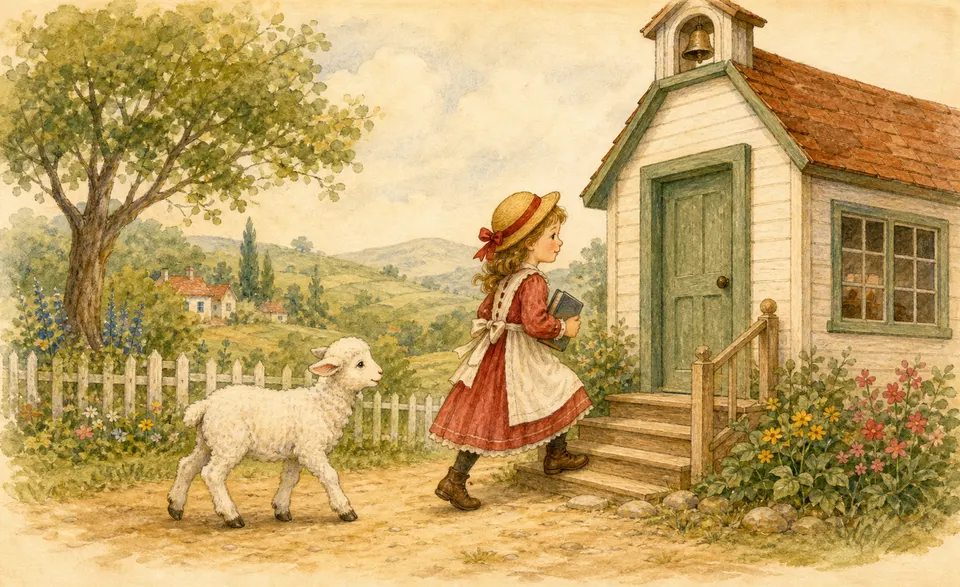
#It followed her to school one day, school one day, school one day, It followed her to school one day, which was against the rules.
#It made the children laugh and play, laugh and play, laugh and play, It made the children laugh and play to see a lamb at school.
#And so the teacher turned it out, turned it out, turned it out, And so the teacher turned it out, but still it lingered near.
#And waited patiently about, patiently about, patiently about, And waited patiently about till Mary did appear.
#"Why does the lamb love Mary so?" Love Mary so? Love Mary so? "Why does the lamb love Mary so?" the eager children cry.
#"Why, Mary loves the lamb, you know." The lamb, you know, the lamb, you know, "Why, Mary loves the lamb, you know," the teacher did reply.
#Mary Had a Little Lamb at a glance
- Country of origin
- 🇺🇸 United States
- Sung in
- English
- Words by
- Sarah Josepha Hale
- First known
- 1830
- Best for ages
- 2–7
- Mood
- playful, traditional
- Last updated
- 27 August 2026
Meaning and origin
Unlike most nursery songs, this one has a named author and a date. Sarah Josepha Hale — an American writer and editor, and the person who campaigned Thanksgiving into a national holiday — published it on 24 May 1830. It may have grown from a real moment: a girl who brought her pet lamb to school, where it waited outside all day until she came out again.
There has always been a small argument about that. In 1876 a woman named Mary Tyler said she was the girl, and that a ministerial student called John Roulstone wrote the first verses after watching the lamb turned out of the classroom. No proof was ever produced, and the earliest real record is still Hale’s 1830 printing — so the poem stays hers.
Its strangest claim to fame has nothing to do with lambs. In 1877 Thomas Edison, testing his brand-new phonograph, spoke the opening line — “Mary had a little lamb” — into the machine. Those were the first words of English verse ever recorded. The original was lost for over a century; a fragment from an 1878 recording was finally read again in 2012 using 3D imaging. A child’s rhyme, by pure accident, became the first thing recorded sound remembered.
Common questions
- Who wrote "Mary Had a Little Lamb"?
- The American writer and editor Sarah Josepha Hale, who published it on 24 May 1830. It may have been inspired by a real event — a girl who brought her pet lamb to school — and in 1876 a woman named Mary Tyler claimed to be that girl and that a student named John Roulstone wrote the first verses, though no evidence for her account ever surfaced.
- Was this really the first sound recording?
- The first words of this rhyme were what Thomas Edison spoke to test his new phonograph in 1877, making it the first recording of English verse. The original was long lost; a fragment was recovered from an 1878 recording using 3D imaging in 2012.
- Is there a real Mary and a real lamb?
- The story is tied to Sterling, Massachusetts, which keeps a statue and markers to it, and to the Redstone School Mary is said to have attended — a building Henry Ford later moved to Sudbury, Massachusetts. How much of the tale is true remains uncertain.