Lyrics
Der vollständige Liedtext von „Die Räder vom Bus“ mit englischer Übersetzung.
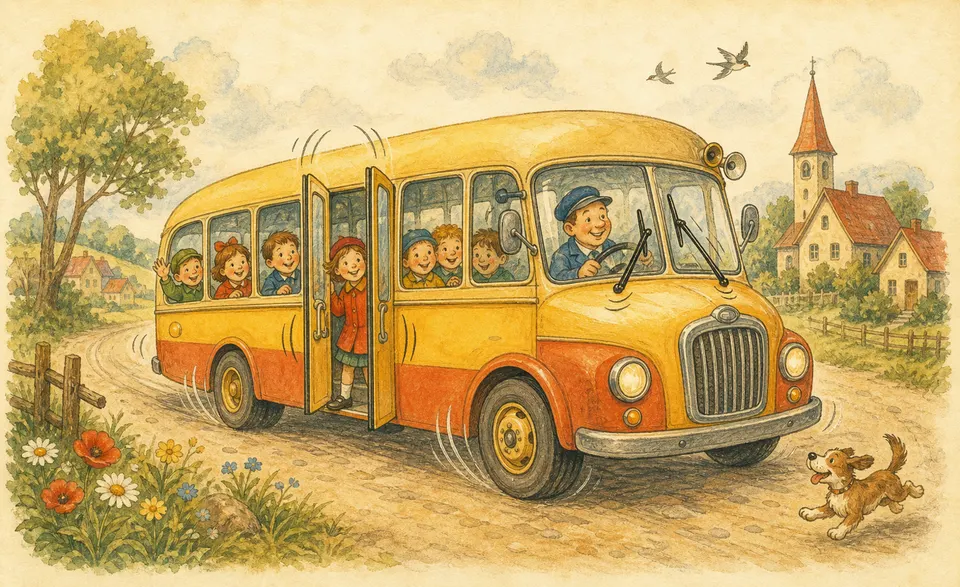
Die Türen vom Bus gehen auf und zu, auf und zu, auf und zu. Die Türen vom Bus gehen auf und zu, stundenlang.
#Die Räder vom Bus, die rollen dahin, rollen dahin, rollen dahin. Die Räder vom Bus, die rollen dahin, stundenlang.
#Die Wischer vom Bus machen wisch, wisch, wisch, wisch, wisch, wisch, wisch, wisch, wisch. Die Wischer vom Bus machen wisch, wisch, wisch, stundenlang.
#Die Hupe vom Bus macht tut, tut, tut, tut, tut, tut, tut, tut, tut. Die Hupe vom Bus macht tut, tut, tut, stundenlang.
#Der Fahrer im Bus sagt: Fahrkarten bitte, Fahrkarten bitte, Fahrkarten bitte. Der Fahrer im Bus sagt: Fahrkarten bitte, stundenlang.
#Die Leute im Bus machen bla, bla, bla, bla, bla, bla, bla, bla, bla. Die Leute im Bus machen bla, bla, bla, stundenlang.
#Die Babys im Bus schlafen tief und fest, tief und fest, tief und fest. Die Babys im Bus schlafen tief und fest, stundenlang.
#English translation
The doors on the bus go open and shut, open and shut, open and shut. The doors on the bus go open and shut, for hours on end. The wheels on the bus, they roll along, roll along, roll along. The wheels on the bus, they roll along, for hours on end. The wipers on the bus go swish, swish, swish, swish, swish, swish, swish, swish, swish. The wipers on the bus go swish, swish, swish, for hours on end. The horn on the bus goes toot, toot, toot, toot, toot, toot, toot, toot, toot. The horn on the bus goes toot, toot, toot, for hours on end. The driver on the bus says: tickets please, tickets please, tickets please. The driver on the bus says: tickets please, for hours on end. The people on the bus go bla, bla, bla, bla, bla, bla, bla, bla, bla. The people on the bus go bla, bla, bla, for hours on end. The babies on the bus sleep sound and deep, sound and deep, sound and deep. The babies on the bus sleep sound and deep, for hours on end.
#Rights
The words are a commonly sung variant of Robert Metcalf’s German version of “The Wheels on the Bus”, whose English original is by Verna Hills (1937); they are still in copyright. They are reproduced here, credited, for family and classroom singing; no reuse licence has been obtained, and nothing on this page may be copied further. Rightsholders can ask for a correction or removal — see lyrics & credits.
Die Räder vom Bus at a glance
- Country of origin
- 🇺🇸 United States
- Sung in
- German
- Version of
- The Wheels on the Bus
- Words by
- Robert Metcalf
- First known
- German text by Robert Metcalf, from his collection "Wenn du zappelig bist"; the English original was published in 1937
- Best for ages
- 2–7
- Mood
- dancing, playful
- Last updated
- 27 August 2026
How to sing it
- Give every verse its own action: open and close your hands for the doors, roll your arms for the wheels, swing them side to side for the wipers.
- Make the sound each time — "auf und zu", "wisch, wisch, wisch", "tut, tut, tut" — as loudly and clearly as you can.
- Add new verses for anything else on the bus and invent a movement to match.
Meaning and origin
This is the German cousin of “The Wheels on the Bus”, and it works in exactly the same happy, repetitive way. Each verse picks one part of the bus — the doors, the wheels, the wipers, the horn — gives it a sound and a hand movement, and repeats it until it is thoroughly worn in. The German verses end not with “all through the town” but with stundenlang, “for hours on end”, which somehow makes the long ride feel even longer and funnier.
The song it comes from is not old by nursery standards: “The Wheels on the Bus” was first published in the United States in 1937, written by Verna Hills, and has since been translated and re-sung all over the world. The German text with its stundenlang refrain is credited to the children’s musician Robert Metcalf, who published it in his collection Wenn du zappelig bist; the version printed here is a commonly sung variant of his words, differing in small details (the order of the verses, Fahrkarten bitte for his Fahrkarte, bitte!). The German version keeps the structure intact — doors that open and shut, wipers that go wisch, wisch, wisch, a horn that goes tut, tut, tut — so that a child who knows one can follow the other at once.
What makes it last is that it is really a game for the whole body. Nobody sits still for it: you open and close your hands for the doors, roll your arms for the wheels, swing them for the wipers. Best of all, it never has to end — you can keep inventing new things on the bus, and a new action to go with each, for as long as the children’s attention holds. Which, on a real bus, is exactly the point.
Common questions
- Is "Die Räder vom Bus" a German song?
- It is the German-language version of "The Wheels on the Bus", an action song that was first published in the United States in 1937. The German verses follow the same idea, giving the doors, wheels, wipers, horn, driver, people and babies each their own sound and gesture.
- Who wrote the German words of "Die Räder vom Bus"?
- The English original, "The Wheels on the Bus", is by the American writer Verna Hills (1898–1990) and was first published in December 1937. The German text with the "stundenlang" refrain is credited, words and melody, to the children's musician Robert Metcalf, who included it in his collection "Wenn du zappelig bist"; the wording sung here is a common variant of his, and both texts are still in copyright.
- How does "Die Räder vom Bus" work?
- Each verse takes one part of the bus and repeats its action and sound over and over — the doors go open and shut, the wipers go "wisch, wisch, wisch", the horn goes "tut, tut, tut" — always ending "stundenlang" ("for hours on end"). It is built to be acted out with the hands and body.
- What does "stundenlang" mean?
- "For hours on end". Where the English version sings "all through the town", the German one ends each verse with "stundenlang", stretching out the long bus ride and inviting the children to keep the actions going.
Sources
- Wikipedia — The Wheels on the Bus
- Liederfarm — Die Räder vom Bus (Text und Melodie: Robert Metcalf)
- robert-metcalf.de — Wenn du zappelig bist (Notenheft; song list)
- Chinder Musig Wält (swissmom) — Die Räder vom Bus (text and variant)
- en.wikipedia.org/wiki/The_Wheels_on_the_Bus
- www.wikidata.org/wiki/Q7774404