Lyrics
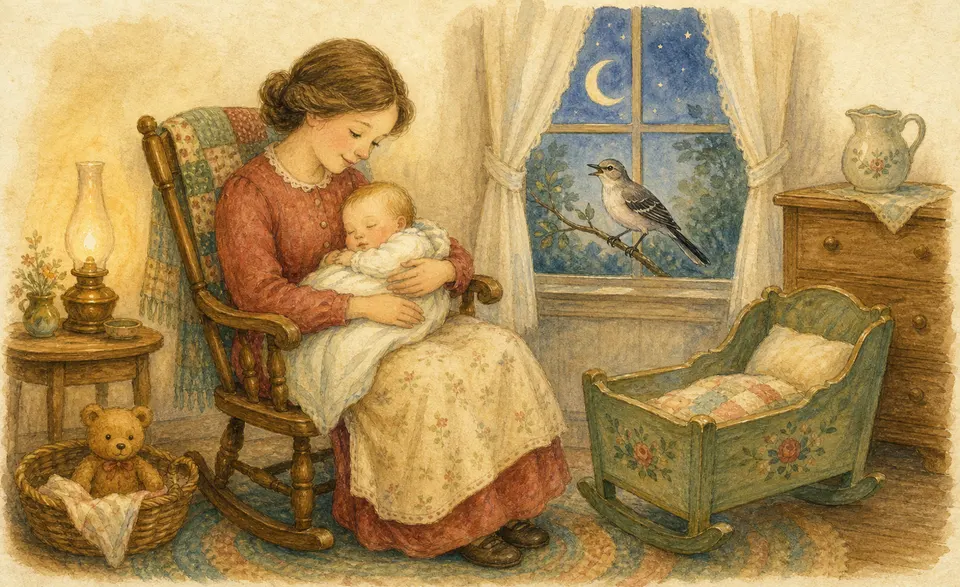
Hush, little baby, don't say a word, Mama's gonna buy you a mockingbird.
#If that mockingbird don't sing, Mama's gonna buy you a diamond ring.
#If that diamond ring turns brass, Mama's gonna buy you a looking glass.
#If that looking glass gets broke, Mama's gonna buy you a billy-goat.
#If that billy-goat don't pull, Mama's gonna buy you a cart and bull.
#If that cart and bull turn over, Mama's gonna buy you a dog named Rover.
#If that dog named Rover don't bark, Mama's gonna buy you a horse and cart.
#If that horse and cart fall down, You'll still be the sweetest baby in town.
#Hush, Little Baby at a glance
- Country of origin
- 🇺🇸 United States
- Sung in
- English
- Words by
- Traditional
- Best for ages
- 2–7
- Mood
- lullaby, calming
- Last updated
- 27 August 2026
Meaning and origin
This is a lullaby that works by piling up promises. A mockingbird, and if it won’t sing, a diamond ring; and if that turns to brass, a looking glass — on and on, each gift replaced the moment it fails, in a long soothing chain that a tired parent can spin out for as long as the baby stays awake. It comes from the American South, and like most folk lullabies nobody knows who made it or when; collectors were already writing versions down by 1918.
Because it is built from simple rhyming couplets, it belongs to whoever is singing. Gifts can be added, dropped or reordered, so almost every family has its own slightly different string of presents. That flexibility is the secret of its long life: it is less a fixed song than a pattern you can keep going by ear.
And the presents, in the end, do not matter. The final lines quietly undo the whole bargain — even if the mockingbird and the ring and the horse and cart all come to nothing, the child is still loved, still “the sweetest baby in town”. The comfort was never in the gifts. It was in the voice, and the promise behind them.
Common questions
- Where does "Hush, Little Baby" come from?
- It is a traditional lullaby thought to have grown up in the Southern United States. Like most folk songs its author and exact age are unknown; it was being collected from singers by the early twentieth century — Cecil Sharp noted a version in Virginia in 1918.
- Why does "Hush, Little Baby" keep promising gifts?
- It is a cumulative song: each line offers the baby something new — a mockingbird, a diamond ring, a looking glass, a billy goat — and each gift that fails is simply replaced by another. Because it is just a chain of rhyming couplets, singers can add or swap gifts freely, so no two families sing quite the same version.
- What is the point of all the presents?
- The gifts are really beside the point. The last lines give the game away: even if everything falls through, the baby is still "the sweetest baby in town", loved regardless. The song's comfort is in the soothing chain of promises, not the promises themselves.