Lyrics
Celotno besedilo pesmi »Marko skače« z angleškim prevodom.
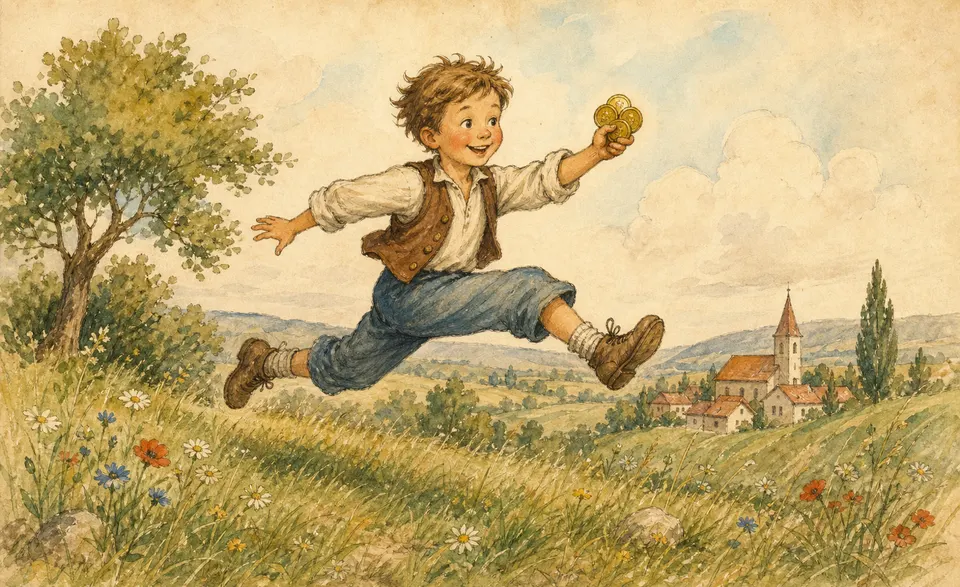
Marko skače, Marko skače po zeleni trati, aj, aj, ajajaj, po zeleni trati.
#V roki nosi, v roki nosi sedem žoltih zlatih, aj, aj, ajajaj, sedem žoltih zlatih.
#English translation
Marko is leaping, Marko is leaping across the green meadow, aj, aj, ajajaj, across the green meadow. In his hand he carries, in his hand he carries seven yellow gold coins, aj, aj, ajajaj, seven yellow gold coins.
#Marko skače at a glance
- Country of origin
- 🇸🇮 Slovenia
- Sung in
- Slovenian
- Words by
- Traditional
- First known
- first written down in the 1830s (Stanko Vraz, published 1839); phonograph recording in Tišina, Prekmurje, 1898
- Best for ages
- 3–9
- Mood
- dancing, playful, traditional
- Last updated
- 24 July 2026
How to sing it
- Form a circle holding hands, with one child — Marko — in the middle.
- The circle walks or skips round during the sung lines; Marko leaps on the spot.
- On "aj, aj, ajajaj" everyone raises their joined hands high.
- At the end of the verse Marko chooses someone to swap places with, and the song starts again.
Meaning and origin
Slovenian children’s songs tend to be short, physical and built around a circle, and this looks like a clear example: two verses, a nonsense refrain, and a game learned at the same time as the words. But the two verses are only the beginning of a much longer song.
In Prekmurje, where it comes from, “Marko skače” is a courtship ballad. Marko leaps across the meadow with seven gold coins in his hand, and the coins are to pay for a bride; he sets off beyond nine and ten bridges to find her, asks her mother for her — “give her to us, our dear mother” — and is refused: “you are old and bearded”. In one version from Beltinci the mother would rather lock her daughter in a chest and let the mice and rats eat her. Kindergartens sing the opening and stop, which is how a wooing song about an ageing suitor became a game for four-year-olds; the dialectologist Tjaša Jakop, who compared the song’s transcriptions, notes that its words have barely changed from village to village but that it has shifted from a courtship song into a children’s one.
It is also one of the best-documented Slovenian folk songs. Stanko Vraz wrote it down in the 1830s and published it in 1839; Karel Štrekelj included it in his great collection; in 1898 the Hungarian folklorist Béla Vikár recorded two singers from Tišina on wax cylinders that are now in Budapest, among the earliest recordings of Slovenian folk music; and in 1909 the linguist Avgust Pavel printed a phonetic transcription from Bratonci, adding that the people around there were nicknamed “Marki” because so many of them were called Marko. The song gives him no other identity.
One word marks the distance between the song and the classroom. Children sing žoltih, an old word for “yellow” that the standard dictionary now labels archaic; but Prekmurje sings seden žuti zlati, in dialect, and žoltih is the tidier form that printed songbooks put in its place. Even that small change tells the song’s story: a dialect ballad from the far east of Slovenia, smoothed into standard Slovenian on its way into every kindergarten in the country.
Common questions
- What does "Marko skače" mean?
- "Marko is leaping" or "Marko is jumping". The first verse has him leaping across a green meadow; the second has him carrying seven gold coins in his hand. Those are the two verses children sing, but the full Prekmurje song goes on: the coins are to pay for a bride, Marko sets off beyond nine and ten bridges to woo her, and her mother refuses him — "you are old and bearded".
- Who is the Marko in the song?
- The song never says — no surname, no title. In the full ballad he is simply a young man with money going to woo a bride in a far country, and for the children singing it he is whoever stands in the middle of the circle. The linguist Avgust Pavel, who transcribed the song in Bratonci in 1909, noted that people of that area were nicknamed "Marki" because every other man was called Marko, and guessed the ballad had arisen there. None of the sources we checked links him with the epic hero Prince Marko.
- Why does "Marko skače" use the word "žoltih" instead of "rumenih"?
- "Žolt" is an old word for yellow: the standard Slovenian dictionary (SSKJ) labels it archaic and glosses it as "rumen". In Prekmurje the song is actually sung in dialect — "seden žuti zlati" — and "žoltih" is the standardised form that printed songbooks use in its place, as the dialectologist Tjaša Jakop notes in her 2021 study of the song's transcriptions.
- How old is "Marko skače"?
- It was first written down in the 1830s by Stanko Vraz, who published it in 1839, and Karel Štrekelj later printed it as no. 5443 of his "Slovenske narodne pesmi". In 1898 the Hungarian ethnomusicologist Béla Vikár recorded it on wax cylinder in the village of Tišina, sung by Anuška Horvat and Ferenc Džuban — among the first recordings of Slovenian folk music, now kept in the Ethnographic Museum in Budapest — and in 1909 Avgust Pavel published a phonetic transcription from Bratonci.
- Is "Marko skače" a dance?
- It is now sung as a circle game in kindergartens and the first years of school; a Slovenian school worksheet on the song says it was originally sung to accompany dancing, with clapping, in Prekmurje, the Porabje region of Hungary and along the Croatian–Slovenian border. The leaping in the lyric is meant to be done.
Sources
- Tjaša Jakop, "Prekmurske ljudske pesmi v glasoslovni razpravi Avgusta Pavla (1909)", Traditiones 50/2 (2021), 79–93 — ZRC SAZU
- OŠ Šoštanj — school worksheet "Ljudska pesem: Marko skače" (full Prekmurje text; sung at dances)
- Fran / SSKJ² — "žolt": star. rumen
- Slovenske narodne pesmi — Marko skače (recording by Moški pevski zbor Slava Klavora)