Lyrics
Celotno besedilo pesmi »Mamica« z angleškim prevodom.
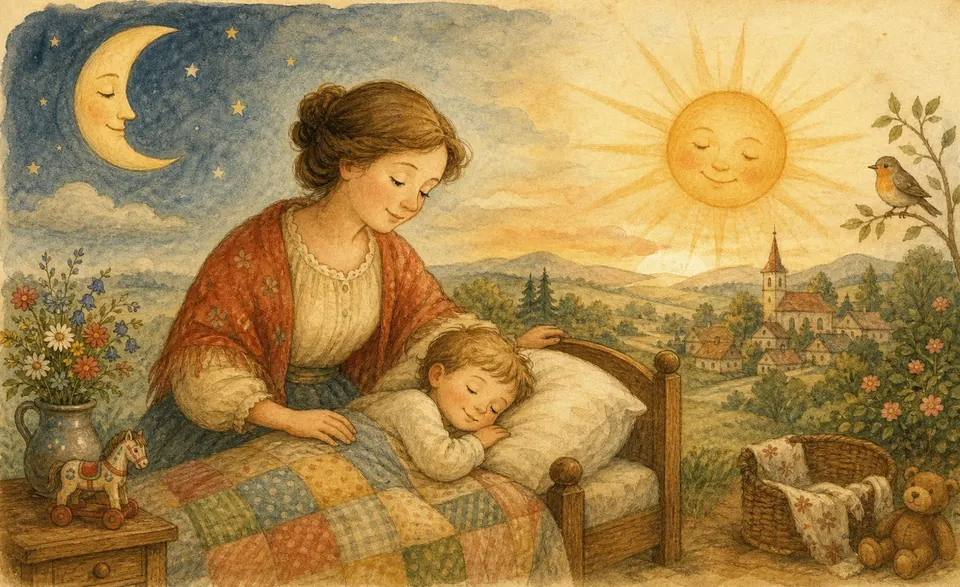
Mamica je kakor zarja, zjutraj se smehlja, ko se v postelji še dete s sanjami igra. In zato nikdar mamice ne dam, eno le na svetu širnem mamico imam.
#Mamica je kakor sonček, srček njen je zlat, kakor žarek, ki posije od nebeških vrat. In zato nikdar...
#Mamica je kakor luna, dolge bdi noči, da počiva njeno dete mirno brez skrbi. In zato nikdar...
#English translation
Mummy is like the dawn, she smiles in the morning, while the child still plays with dreams in bed. And so I'll never give my mummy up, I have but one mummy in all the wide world. Mummy is like the little sun, her heart is golden, like a ray that shines from heaven's gates. And so I'll never… Mummy is like the moon, she keeps watch through long nights, so her child may rest peacefully, free of care. And so I'll never…
#Mamica at a glance
- Country of origin
- 🇸🇮 Slovenia
- Sung in
- Slovenian
- Words by
- Franjo Neubauer
- First known
- words by Franjo Neubauer (1872–1945); tune listed as a Croatian folk melody
- Best for ages
- 2–7
- Mood
- lullaby, traditional
- Last updated
- 27 August 2026
Meaning and origin
This is one of the tenderest of Slovenian songs about mothers, and it works by likening mummy, verse by verse, to three great lights. She is like the dawn, smiling in the morning while her child still plays among its dreams; like the little sun, with a golden heart, a ray shining from heaven’s gates; and like the moon, keeping watch through the long nights so that her child sleeps peacefully and without a care. Each image places the mother among the very things that light and warm the world.
Running through it is a simple, fierce vow that any child understands: I’ll never give my mummy up — I have but one in all the wide world. It is a song children sing to their mothers, offered on Slovenian parenting sites as a Mother’s Day gift, and it has passed so fully into popular singing that folk-song portals file it as traditional. The words, though, have an author: Franjo Neubauer (1872–1945), a poet and priest from Mirna in Lower Carniola, whom Mitja Gobec’s 2018 collection of Slovenian songs turned folk credits for the text, set to what it calls a Croatian folk tune; no composer of the melody is named. Whoever first sang it, it says something every child means: that of all the lights in the sky, none shines quite like their own mother.
Common questions
- What is "Mamica" about?
- A child's love for its mother, through three images of light. Mummy is like the dawn (she smiles in the morning while the child still dreams), like the little sun (her heart is golden, a ray from heaven's gates), and like the moon (she keeps watch through long nights so her child sleeps peacefully). The refrain vows: I'll never give up my mummy — I have only one in all the wide world.
- When is "Mamica" sung?
- It is a song for mothers: Mitja Gobec's collection of Slovenian songs that passed into folk tradition lists it under the alternative title "Moja mamica" ("My Mummy"), and Slovenian parenting sites offer it among poems to give a mother for Mother's Day — a warm, grateful song a child sings to or about their mother.
- Who wrote "Mamica"?
- The words are by Franjo Neubauer (1872–1945), a Slovenian poet and priest from Mirna: Mitja Gobec's "Sto slovenskih ponarodelih pesmi" (2018) lists the song as Neubauer's words to a Croatian folk tune, and the lyrics site Besedilo.si credits him likewise, marking the music as folk. The song has passed so fully into popular singing that folk-song portals file it as traditional, and no composer of the melody is named in any source we found.
Sources
- Mitja Gobec, Sto slovenskih ponarodelih pesmi (JSKD, 2018) — contents listing: "Mamica je kakor zarja (Moja mamica) Franjo Neubauer/hrvaški napev"
- Besedilo.si — Mamica je kakor zarja (besedilo: Franjo Neubauer; glasba: ljudska)
- Slovenska biografija — Neubauer, Franjo (1872–1945)
- Ringaraja — Pesmi o mami in za mamo
- Slovenske narodne pesmi — Mamica je kakor zarja (recording)