Lyrics
La letra completa de «Los Pollitos Dicen» con traducción al inglés.
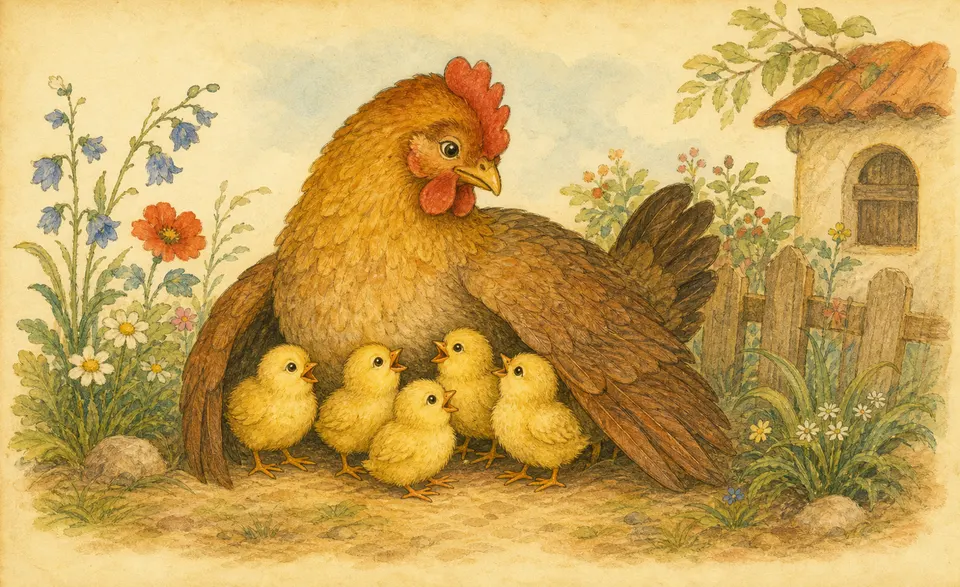
Los pollitos dicen, pío, pío, pío, cuando tienen hambre, cuando tienen frío. La gallina busca el maíz y el trigo, les da la comida y les presta abrigo.
#English translation
The little chicks say cheep, cheep, cheep, when they are hungry, when they are cold. The hen looks for the maize and the wheat, gives them their food and keeps them warm.
#Los Pollitos Dicen at a glance
- Country of origin
- 🇨🇱 Chile
- Sung in
- Spanish
- Words by
- Ismael Parraguez
- First known
- 1907, in Ismael Parraguez’s "Poesías infantiles" (Chile)
- Best for ages
- 2–7
- Mood
- lullaby, traditional
- Last updated
- 27 August 2026
Meaning and origin
For millions of Spanish-speaking children, this is one of the very first songs they ever hear. Its picture could not be simpler or gentler: the little chicks cheep — pío, pío, pío — when they are hungry and when they are cold, and their mother hen goes searching for maize and wheat to feed them and tucks them under her wing to keep them warm. Sung slowly, it is really a lullaby about being cared for, which is exactly why it soothes.
It is sung across the whole Spanish-speaking world, carried by ear through Spain and Latin America in countless small variations, and it is so widely known that many songbooks and websites file it as traditional. But it has an author: Ismael Parraguez (1883–1917), a Chilean teacher and poet who, as the National Library of Chile tells it, taught music and poetry to children and published the poem in his 1907 Poesías infantiles, a book written for the children of Chile. From there it travelled, and what carried it was its warmth. Behind the chicks and the hen is the oldest reassurance a small child can be given: that when you cry out, someone will come with food and shelter.
Common questions
- What does "Los pollitos dicen" mean?
- The little chicks say "pío, pío, pío" (cheep, cheep, cheep) when they are hungry and when they are cold. The mother hen searches for maize and wheat, gives them their food and keeps them warm. It is a tender picture of a mother caring for her babies, which is why it doubles as a lullaby.
- Where is "Los Pollitos Dicen" from, and who wrote it?
- It comes from Chile. The National Library of Chile describes its author, Ismael Parraguez (1883–1917), as a Chilean teacher-training graduate who taught music and poetry to children, and places the song in his book of 1907, "Poesías infantiles", written for the children of Chile. It has since spread by ear across Latin America and Spain, and because it is so widely sung, songbooks and websites often list it simply as traditional.
- How is "Los Pollitos Dicen" usually sung?
- Softly, as a cradle song, with the "pío, pío, pío" imitating the chicks. It is one of the first songs many Spanish-speaking children learn, and its question-and-answer shape (why do they cheep? because they're hungry or cold) makes it easy to remember.