Lyrics
Der vollständige Liedtext von „Alle Leute gehen jetzt nach Haus“ mit englischer Übersetzung.
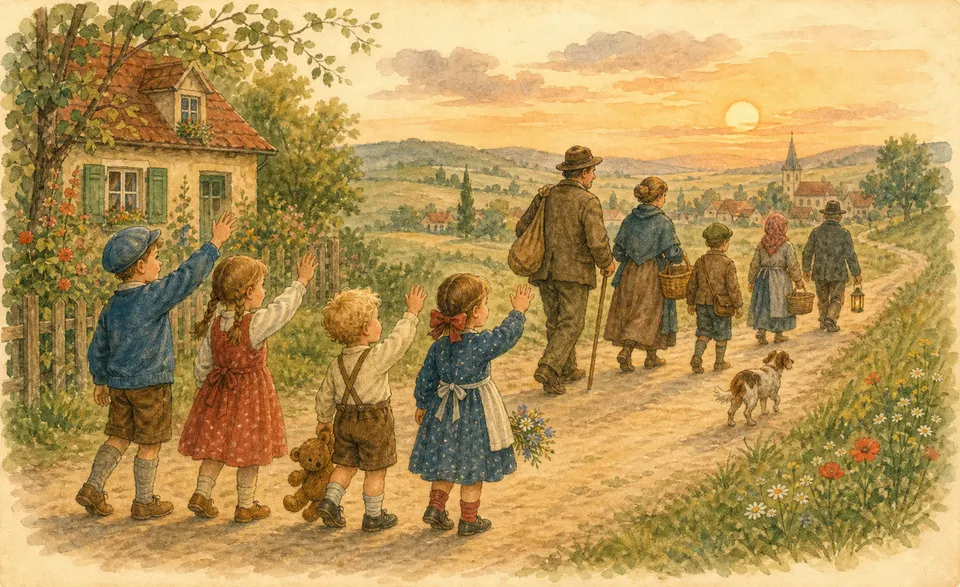
Alle Leut, alle Leut gehn jetzt nach Haus, gehn in ihr Kämmerlein, lassen fünf grade sein. Alle Leut, alle Leut gehn jetzt nach Haus.
#Alle Leut, alle Leut gehn jetzt nach Haus, große Leut, kleine Leut, dicke Leut, dünne Leut. Alle Leut, alle Leut gehn jetzt nach Haus.
#Alle Leut, alle Leut gehn jetzt nach Haus, sagen auf Wiedersehen, es war so wunderschön. Alle Leut, alle Leut gehn jetzt nach Haus.
#English translation
Everyone, everyone is going home now, going to their little rooms, letting five be even. (i.e. not fussing over details) Everyone, everyone is going home now. Everyone, everyone is going home now, big people, little people, fat people, thin people. Everyone, everyone is going home now. Everyone, everyone is going home now, saying goodbye, it was so lovely. Everyone, everyone is going home now.
#Alle Leute gehen jetzt nach Haus at a glance
- Country of origin
- 🇩🇪 Germany
- Sung in
- German
- Words by
- Traditional
- First known
- traditional; author unknown, traditional melody
- Best for ages
- 2–7
- Mood
- playful, traditional
- Last updated
- 27 August 2026
How to sing it
- Walk on the spot on "gehn jetzt nach Haus"; on "Kämmerlein" make a little roof over your head with your hands, and on "fünf grade sein" spread your fingers.
- Stretch your arms up for "große Leut" and crouch down for "kleine Leut"; hold your arms out wide for "dicke Leut" and press your palms together in front of you for "dünne Leut".
- Wave on "auf Wiedersehen" and hop on "wunderschön".
Meaning and origin
This is a song for the end of the day. In kindergartens and children’s groups it does exactly what it says: everyone is going home now, off to their own little rooms, so we say a warm goodbye — es war so wunderschön, “it was so lovely” — and part until tomorrow. Some songbooks print it under the title Kehraus, the old word for the last dance that clears the room when a gathering breaks up.
The middle verse turns the parting into a game of opposites: big people and little people, fat people and thin people. The game instructions that come with the song give each line a movement — arms stretched high, a crouch, arms held out wide, palms pressed together — and the Liederkiste songbook adds a roof made of hands for the Kämmerlein and spread fingers for fünf grade sein, literally “letting five be even”, a German saying about not fussing over small things. It is a folk and children’s song with no known author and a traditional melody, and the verses drift a little from one songbook to the next; it survives because every day, everywhere, eventually has to end — and this is a kind way to end it.
Common questions
- When is "Alle Leute gehn jetzt nach Haus" sung?
- At the end. It is a farewell song used in kindergartens and children's groups to round off the day: everyone is going home now, so we say goodbye. One verse spells it out: "sagen auf Wiedersehen, es war so wunderschön" ("we say goodbye, it was so lovely"). Some songbooks title it "Kehraus" — the word for the last dance that clears the room.
- What happens in the verses?
- The middle verse plays with opposites — big people and little people, fat people and thin people — and the published game instructions give each a movement: arms stretched up, a crouch, arms held wide, palms pressed together. The Liederfarm songbook site prints the tune in 3/4 time.
- Who wrote "Alle Leute gehen jetzt nach Haus"?
- No author is known. The songbooks that carry it describe it as a traditional folk and children's song with a traditional melody, and the verses vary a little from one to the next.