Lyrics
Der vollständige Liedtext von „Backe, backe Kuchen“ mit englischer Übersetzung.
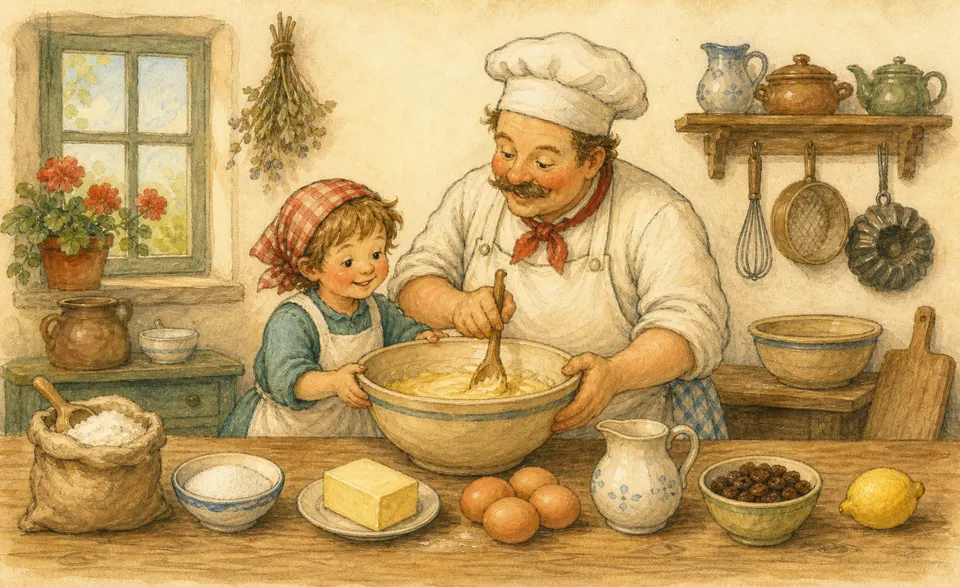
Backe, backe Kuchen, der Bäcker hat gerufen. Wer will guten Kuchen backen, der muss haben sieben Sachen: Eier und Schmalz, Zucker und Salz, Milch und Mehl, Safran macht den Kuchen gehl. Schieb, schieb in'n Ofen 'nein.
#English translation
Bake, bake a cake, the baker has called out! Whoever wants to bake a good cake must have seven things: eggs and lard, sugar and salt, milk and flour, saffron makes the cake yellow. Slide it, slide it into the oven!
#Backe, backe Kuchen at a glance
- Country of origin
- 🇩🇪 Germany
- Sung in
- German
- Words by
- Traditional
- First known
- before 1840 (presumed); rhymed ingredient list c. 1450
- Best for ages
- 2–7
- Mood
- playful, traditional
- Last updated
- 27 August 2026
How to sing it
- Count the seven ingredients off on your fingers as you name them.
- On "Schieb, schieb in'n Ofen 'nein!" push both hands forward as if sliding the cake into the oven.
Meaning and origin
This is Germany’s great baking song, and it is really a list: seven things for a good cake, named in pairs, and a push into the oven at the end. The baker “has called” — the German Wikipedia article traces this line to an old custom in which bakers, having finished the bread, blew a horn to tell the women of the neighbourhood that the leftover heat of the oven was now free for their cakes.
That list is older than the song. “Backe, backe Kuchen” is thought to date from before 1840, in Saxony and Thuringia, but its rhymed recipe already appears around 1450 in the cookbook of Maister Hannsen, cook to the lord of Württemberg — not yet for a cake but for a good Mus, a mash: milch, saltz und schmaltz, zugker, ayer und mel, saffran dar zu, so wirt es gell. The song has kept, almost word for word, a way of remembering a recipe that is nearly six centuries old.
One line even preserves a lost word. Safran macht den Kuchen gehl — saffron makes the cake yellow — uses the old form “gehl” (or “gel”) rather than the modern German “gelb”, because “gehl” rhymes with “Mehl”, flour. The children singing it are keeping alive both a medieval recipe and a scrap of older German, without ever knowing they are doing either.
Common questions
- What is "Backe, backe Kuchen" about?
- Baking a cake. The baker has called, and to make a good cake you need seven things — eggs and lard, sugar and salt, milk and flour, and saffron to turn it yellow — before it is pushed into the oven. It is a list song, and the seven things can be counted off on the fingers.
- How old is "Backe, backe Kuchen"?
- The song is presumed to date from before 1840, in Saxony and Thuringia, but its rhymed list of ingredients is far older: a Württemberg cookbook from around 1450 gives the same seven things — milk, salt, lard, sugar, eggs, flour and saffron — in rhyme, as the recipe for a good "Mus" (a mash), not yet a cake.
- What does "Safran macht den Kuchen gehl" mean?
- "Saffron makes the cake yellow." Saffron was used to give baked goods a golden colour. The old word "gehl" (also written "gel") is kept because it rhymes with "Mehl" (flour) — the modern German "gelb" would not.