Lyrics
Der vollständige Liedtext von „Alle meine Entchen“ mit englischer Übersetzung.
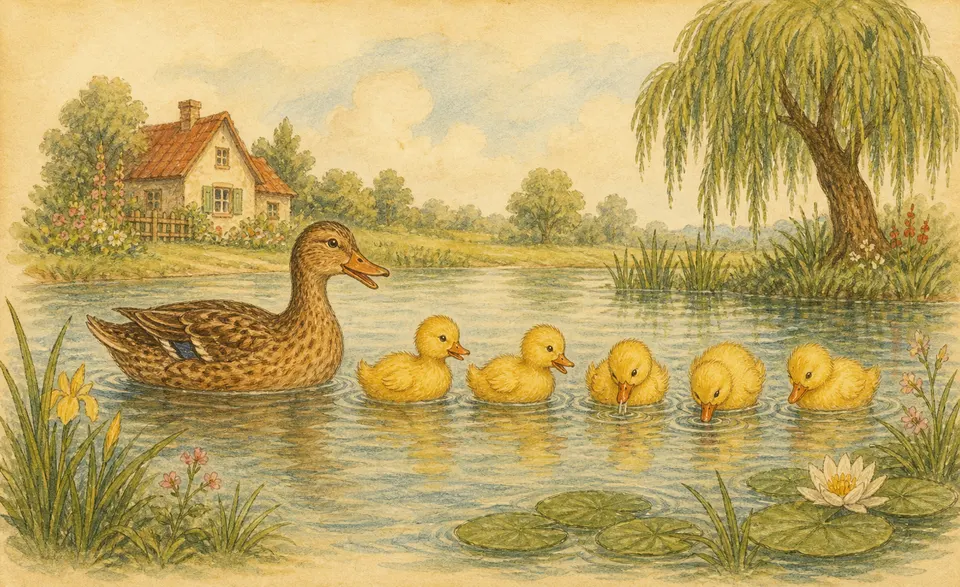
Alle meine Entchen schwimmen auf dem See, schwimmen auf dem See, Köpfchen in das Wasser, Schwänzchen in die Höh'.
#English translation
All my little ducklings swimming on the lake, swimming on the lake, little heads down in the water, little tails up in the air.
#Alle meine Entchen at a glance
- Country of origin
- 🇩🇪 Germany
- Sung in
- German
- Words by
- Traditional
- First known
- melody 18th c.; text 19th c.
- Best for ages
- 2–7
- Mood
- playful, traditional
- Last updated
- 25 July 2026
Meaning and origin
This is often the very first song a German child learns, and it is hard to imagine a gentler one. There is no story — only a row of ducklings on a lake, heads dipping under the water, tails tipping up into the air — and that single soft image, sung slowly, sits somewhere between a nursery song and a lullaby.
Its history is a little lopsided. The melody is the old part, documented from around the middle of the 18th century, where it turns up in dance manuscripts; the familiar words came later, in the 19th century. A composer named Ernst Anschütz is sometimes given the credit, but it cannot be verified, and the song was simply passed around until collectors wrote it down — one did so in a book of Hessian children’s songs in 1891.
The tune has a surprisingly wide family. That plain rising phrase at the start echoes through a good deal of European music: you can hear its shape at the opening of the Israeli national anthem “Hatikvah” and in Smetana’s great river piece “The Moldau”. A song about ducklings, it turns out, shares its first few notes with some very grand company.
Common questions
- What is "Alle meine Entchen" about?
- Very little, gently observed: a row of ducklings swimming on a lake, dipping their heads into the water and tipping their tails up in the air. Further verses add pigeons, chickens and geese doing much the same. It is a first song for very young children, close to a lullaby in feel.
- How old is "Alle meine Entchen"?
- The melody is documented from around the middle of the 18th century — it appears in old dance manuscripts — while the words are usually dated to the 19th century. Ernst Anschütz is sometimes credited, but that cannot be confirmed; the song was in print in a collection of Hessian children's songs by 1891.
- Why does the tune sound familiar?
- Because that simple rising phrase turns up in many places. Related melodies appear in other European songs, and the same opening shape is heard at the start of the Israeli anthem "Hatikvah" and in Smetana's "Vltava (The Moldau)".