Lyrics
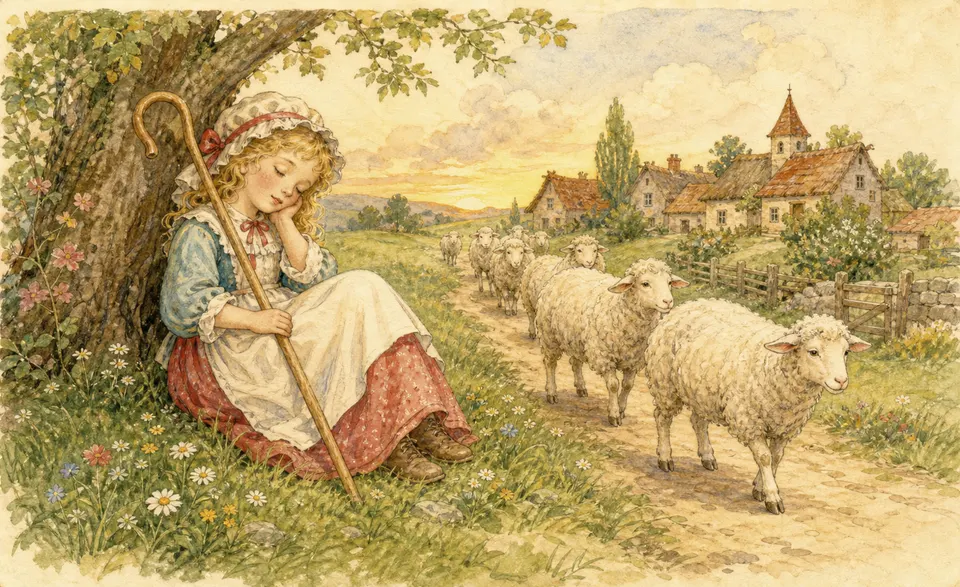
Little Bo-Peep has lost her sheep, And can't tell where to find them; Leave them alone, and they'll come home, And bring their tails behind them.
#Little Bo Peep at a glance
- Country of origin
- 🇬🇧 United Kingdom
- Sung in
- English
- Words by
- Traditional
- First known
- c. 1805
- Best for ages
- 2–7
- Mood
- playful, traditional
- Last updated
- 27 August 2026
Meaning and origin
There is a gentle wisdom hidden in this one. Bo-Peep has lost her sheep and does not know where to look — and the rhyme’s advice is to do nothing: leave them alone, and they will come home on their own. For a small, anxious child that is a quietly reassuring idea, that some lost things find their own way back.
It is younger than many nursery rhymes. The earliest manuscript dates to around 1805, with the first printing in 1810, and the familiar tune was noted down in 1870. The name is older than the rhyme, though. From the 14th century “to play bo peep” meant being stood in a pillory — in 1364 an ale-wife, Alice Causton, was convicted of giving short measure and had to “play bo peep thorowe a pillery” — and a fifteenth-century ballad was already pairing the phrase with sheep: “Halfe England ys nowght now but shepe / In every corner they play boe-peep.” Here “little” describes her size, not her age.
The longer version turns faintly surreal. Bo-Peep falls asleep, sets off to find the sheep, and discovers that their tails have somehow come off and been left hanging on a tree to dry — an odd image that is really a glimpse of farm life, where lambs’ tails were commonly docked.
Common questions
- How old is "Little Bo-Peep"?
- The earliest manuscript is from around 1805, and it was first printed in 1810 in "Gammer Gurton's Garland". The tune usually sung was written down by James William Elliott in 1870.
- Does "Little" mean she is a child?
- Not necessarily. In the rhyme "little" refers to Bo-Peep being small in stature rather than young. The phrase "to play bo peep" is much older than the rhyme: from the 14th century it meant being stood in a pillory, and a fifteenth-century ballad already links it with sheep ("Halfe England ys nowght now but shepe / In every corner they play boe-peep").
- What is the rest of the story?
- In the fuller version Bo-Peep falls asleep hoping to find her flock, and when she does find the sheep she discovers their tails have come off and been hung on a tree to dry — a nod to the real practice of docking lambs' tails.