Lyrics
Celotno besedilo pesmi »Jaz sem mala miška« z angleškim prevodom.
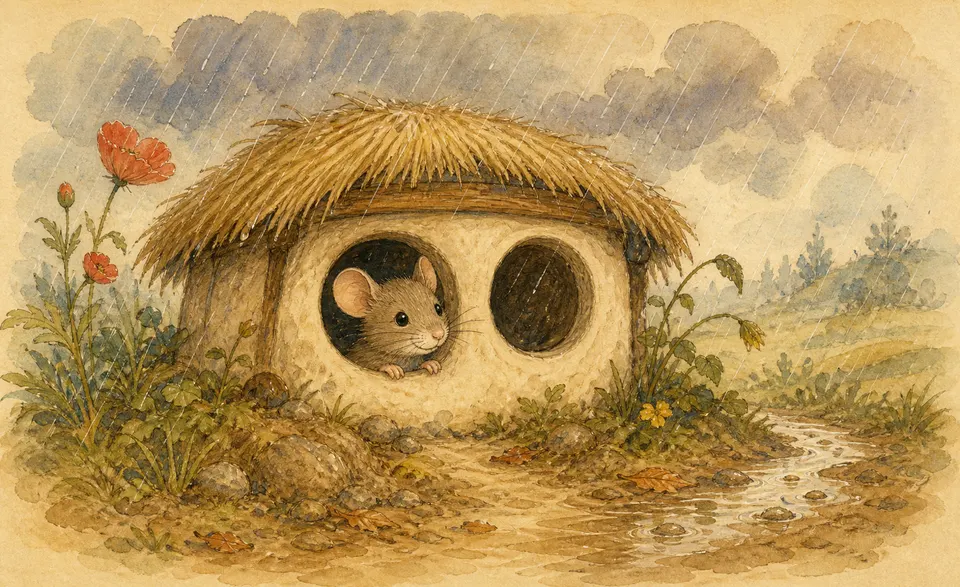
Jaz sem mala miška, saj me vsak pozna. Moja stara hiška luknji dve ima. Skozi prvo luknjo veter se podi, a pri drugi luknji črn muc preži. Včasih dežek pada, mokro je povsod, jaz pa mala miška, grem na dolgo pot: škrap, škrap, škrap – grem z dežja pod kap.
#English translation
I'm a little mouse, everyone knows me. My old little house has two holes. Through the first hole the wind goes chasing, but at the second hole a black cat lurks. Sometimes the rain falls, it's wet everywhere, and I, little mouse, set off on a long journey: scratch, scratch, scratch — I go from the rain in under the eaves.
#Rights
The words are by Slavko Jug and are published with the author’s permission under the CC BY-SA licence.
Jaz sem mala miška at a glance
- Country of origin
- 🇸🇮 Slovenia
- Sung in
- Slovenian
- Words by
- Slavko Jug
- First known
- poem "Miška" by Slavko Jug, first published in his collection "Nasmejane črke" (1974) and reprinted in the picture book "Počesane ribe" (2000); melody by Albin Weingerl
- Best for ages
- 2–7
- Mood
- playful, traditional
- Last updated
- 27 August 2026
Meaning and origin
This is a song sung from mouse-height. A little mouse introduces herself — everyone knows her, she says — and shows off her home, an old house with exactly two holes. But each hole has its hazard: through the first the wind comes chasing, and at the second a black cat lies in wait. It is a small mouse’s-eye view of a world full of everyday dangers, told without a trace of fear, and it ends in a scurry: when the rain falls and everything is wet, off she goes on a long journey — škrap, škrap, škrap, the scratch of little feet as she darts in under the eaves.
The words are not anonymous. They are the poem “Miška” by Slavko Jug (1934–1997), a poet, translator, editor and journalist from Maribor, first published in his 1974 collection Nasmejane črke (“Smiling Letters”), reprinted in the picture book Počesane ribe (“Combed Fish”) in 2000, and reproduced on Slovenian Wikisource with his written permission under a Creative Commons licence. Singers often stretch the poem’s fourteen lines into three sung verses and repeat the last two lines as a refrain, and many say škrab rather than the printed škrap; the text here follows the published poem. The melody is by Albin Weingerl (1923–2010), a composer and choirmaster who after the war edited the children’s magazine Ciciban.
Common questions
- What is "Jaz sem mala miška" about?
- A little mouse introducing herself. Everyone knows her, she says, and her old house has two holes: through the first the wind goes chasing, and at the second a black cat lurks. Sometimes the rain falls and everything is wet — and off she goes on a long journey, "škrap, škrap, škrap", from the rain in under the eaves.
- What does "škrap, škrap" mean?
- It is the scratching, scurrying sound of the little mouse's feet, turned into the poem's last line. "Grem z dežja pod kap" means "I go from the rain in under the eaves" — the mouse hurrying to shelter. The poem as published spells it "škrap"; many singers say "škrab".
- Who wrote "Jaz sem mala miška"?
- The words are the poem "Miška" ("Mouse") by Slavko Jug (1934–1997), a poet, translator, editor and journalist from Maribor. It first appeared in his 1974 collection of children's poems "Nasmejane črke" ("Smiling Letters", Državna založba Slovenije), was reprinted in his picture book "Počesane ribe" ("Combed Fish", Mladinska knjiga, 2000, illustrated by Silvan Omerzu), and is reproduced on Slovenian Wikisource with the author's written permission under a Creative Commons BY-SA 3.0 licence. The melody is by the composer Albin Weingerl (1923–2010).
Sources
- Wikivir — Miška (Slavko Jug), published with the author's written permission, CC BY-SA 3.0
- Wikipedija — Slavko Jug (bibliography: "Nasmejane črke", DZS 1974; "Počesane ribe", Mladinska knjiga 2000)
- Vrtec Bambi — Pesem Miška (heads the song "Miška (Albin Weingerl)")
- Wikipedija — Albin Weingerl (composer, 1923–2010)