Lyrics
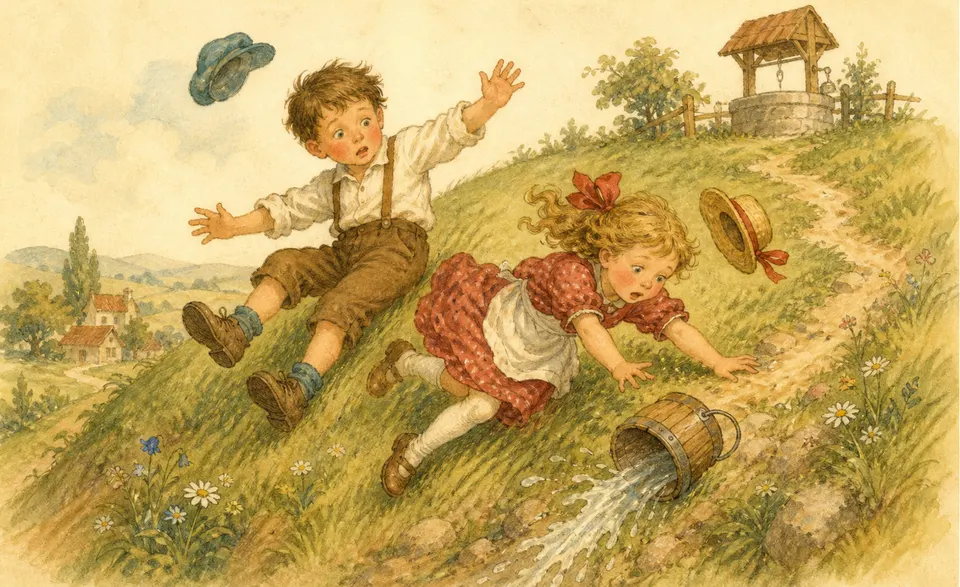
Jack and Jill went up a hill, To fetch a pail of water; Jack fell down and broke his crown, And Jill came tumbling after.
#Jack and Jill at a glance
- Country of origin
- 🇬🇧 United Kingdom
- Sung in
- English
- Words by
- Traditional
- First known
- c. 1765
- Best for ages
- 2–7
- Mood
- playful, traditional
- Last updated
- 27 August 2026
Meaning and origin
Four lines, one small disaster: two children go up a hill for water, and both come down it much faster than they went up. It has been in print since about 1765, and the tumbling second half — Jack breaking his crown, Jill following — is the part every child remembers, usually with a certain relish.
Like most famous rhymes, it has collected grand explanations. Jack and Jill have been said to be figures from Icelandic myth, two royal officials executed in 1510, or a joke about King Charles I and a tax on the “jack” and “gill” measures of drink. All of them run into the same obvious problem: nearly all of these readings were invented after the rhyme was already in print, and none can be shown to be true.
The plainest answer may be the best. The historian Edward A. Martin suggested that pails of water may readily have been collected from dew ponds, which were located on hilltops — in which case a boy and girl carrying a pail uphill was simply a picture of an everyday chore, one that, on at least one occasion, ended with a spilled pail and two bumped heads.
Common questions
- How old is "Jack and Jill"?
- The earliest known version is from about 1765, in a reprint of John Newbery's "Mother Goose's Melody". The first verse everyone knows is the original; the later verses about vinegar and brown paper were added afterwards.
- Is the rhyme about King Charles I, or a beheading?
- Those are among several theories — including links to Icelandic myth, to two men executed in 1510, and to a tax on liquid measures — but almost all of them come after the rhyme was first printed, and none has any corroborating evidence.
- Why would children go uphill for water?
- It sounds odd, but it need not be. The historian Edward A. Martin suggested a more prosaic origin: pails of water may readily have been collected from dew ponds, which were located on the tops of hills. If so, a pair of children climbing a hill with a pail is simply a scene from everyday rural life — though that, too, is a suggestion rather than a proven fact.