Lyrics
Hot cross buns! Hot cross buns! One a penny, two a penny. Hot cross buns!
#If you have no daughters, Give them to your sons! One a penny, two a penny. Hot cross buns!
#Hot Cross Buns at a glance
- Country of origin
- 🇬🇧 United Kingdom
- Sung in
- English
- Words by
- Traditional
- First known
- 1733
- Best for ages
- 2–7
- Mood
- playful, traditional, seasonal
- Last updated
- 25 July 2026
Meaning and origin
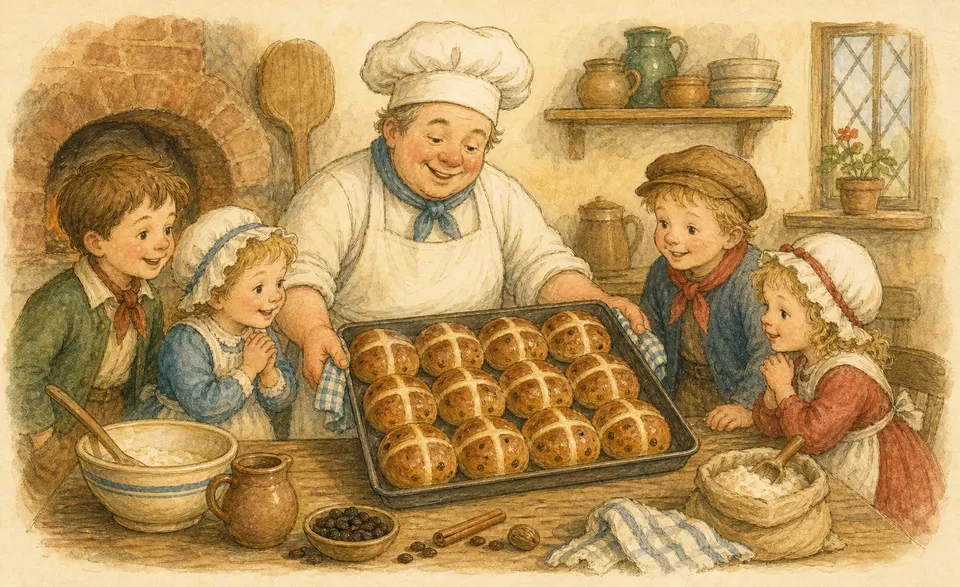
This song started life not in a nursery but in the street. It is a seller’s cry — the sing-song call a baker or hawker used to sell spiced buns — and you can still hear the sales pitch in it: one a penny, two a penny, the price chanted to catch a passer-by. The earliest printed version dates from 1733, and a form close to today’s was published as a round in 1767.
The buns themselves give the song its season. A hot cross bun is a sweet, spiced bun marked with a cross, tied to the end of Lent and eaten on Good Friday, so the cry belonged to a particular few weeks of the year when the buns were baked and sold.
Long after the street sellers fell silent, the tune found a second life in the classroom. Short, gentle and moving mostly by neighbouring notes, “Hot Cross Buns” became one of the first pieces children learn on an instrument — often the very first thing a beginner plays on the recorder — which is why so many people know its three notes before they know where it came from.
Common questions
- What are hot cross buns?
- Hot cross buns are spiced sweet buns marked on top with a cross. They are associated with the end of Lent and are traditionally eaten on Good Friday in Britain and many other countries. The song is the cry a street seller would call to sell them.
- How old is "Hot Cross Buns"?
- The earliest recorded version is from 1733, in "Poor Robin's Almanack". A form very close to the modern one was printed as a round in the "London Chronicle" in June 1767.
- Why is "Hot Cross Buns" used so often in music lessons?
- Because it is short, stepwise and easy to play. Once it passed from a street cry into a nursery rhyme, it became a standard first piece for children learning an instrument — especially the recorder — and it still is.
- What does "one a penny, two a penny" mean?
- It is the seller's price, called out in the street: buns at one penny or two pennies each. The whole song is really an advertisement, sung to catch the ear of passers-by.