Lyrics
Der vollständige Liedtext von „Hopp, hopp, hopp, Pferdchen lauf Galopp“ mit englischer Übersetzung.
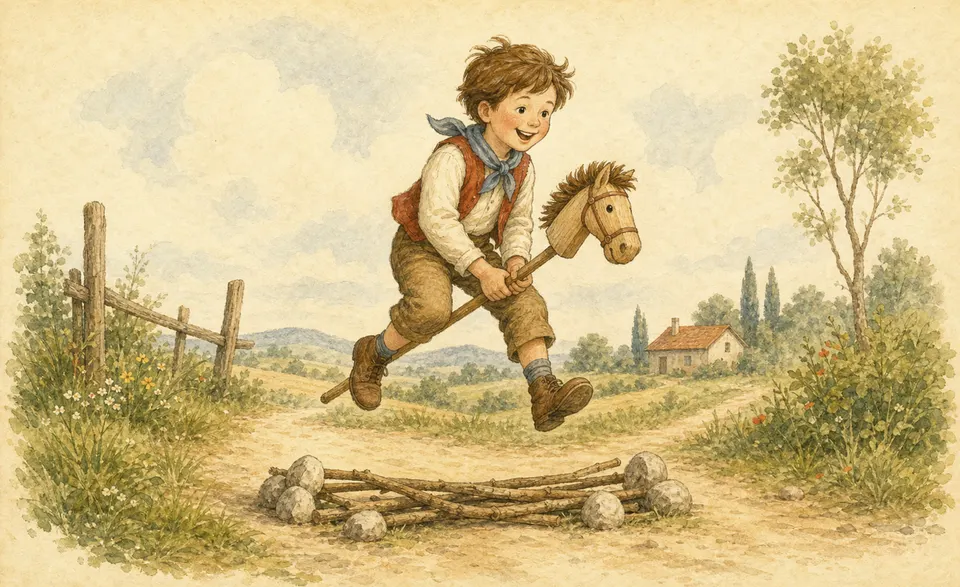
Hopp, hopp, hopp, Pferdchen lauf Galopp! Über Stock und über Steine, aber brich dir nicht die Beine! Hopp, hopp, hopp, hopp, Pferdchen lauf Galopp!
#English translation
Hop, hop, hop, little horse, gallop away! Over sticks and over stones, but don't go breaking your legs! Hop, hop, hop, hop, little horse, gallop away!
#Hopp, hopp, hopp, Pferdchen lauf Galopp at a glance
- Country of origin
- 🇩🇪 Germany
- Sung in
- German
- Words by
- Karl Hahn
- First known
- text 1808; melody 1809
- Best for ages
- 2–7
- Mood
- playful, traditional
- Last updated
- 25 July 2026
How to sing it
- Bounce a child on your knee like a rider on a trotting horse, or let them gallop on a hobby-horse.
- Speed up on "Hopp, hopp, hopp" and steady the pace on "lauf Galopp".
- On "aber brich dir nicht die Beine!" give a playful little wobble, then carry on galloping.
Meaning and origin
This is one of Germany’s favourite movement songs — a gallop set to music. A child either bounces on a grown-up’s knee like a rider on a trotting horse, or charges around the room on a hobby-horse, urging the little steed on: gallop away, over sticks and over stones, but mind you don’t break your legs! The mock warning at the end is half the fun, a tiny wobble before the galloping resumes.
Unusually for a nursery song, its makers are known. The words were written by a schoolmaster, Karl Hahn (1778–1854), who reworked older traditional verses and published them around 1808 under the charming title Steckenpferdliedchen — the “little hobby-horse song”. The tune came a year later, in 1809, composed by Carl Gottlieb Hering (1766–1853), a prolific writer of songs for children.
More than two centuries on, it is still doing exactly the job it was written for. It gives a small child a reason to bounce, gallop and laugh, and it packs a whole country ride — the rough ground, the headlong speed, the little scare — into six short lines. Few songs turn so little into so much motion.
Common questions
- What is "Hopp, hopp, hopp, Pferdchen lauf Galopp" about?
- A hobby-horse. The child urges the little horse to gallop away — over sticks and over stones — but warns it not to break its legs. It is a movement song, played either as a knee-bounce for a baby or as a galloping game for a child on a hobby-horse.
- Who wrote "Hopp, hopp, hopp, Pferdchen lauf Galopp"?
- The words were written by the schoolmaster Karl Hahn (1778–1854), following older traditional models, and published around 1808 under the title "Steckenpferdliedchen" (little hobby-horse song). The melody was composed by Carl Gottlieb Hering (1766–1853) and published in 1809.
- What does "über Stock und über Steine" mean?
- "Over stick and over stones" — a common German expression for rushing along roughly and headlong, over any obstacle. Here it pictures the little horse galloping wildly across the countryside.