Lyrics
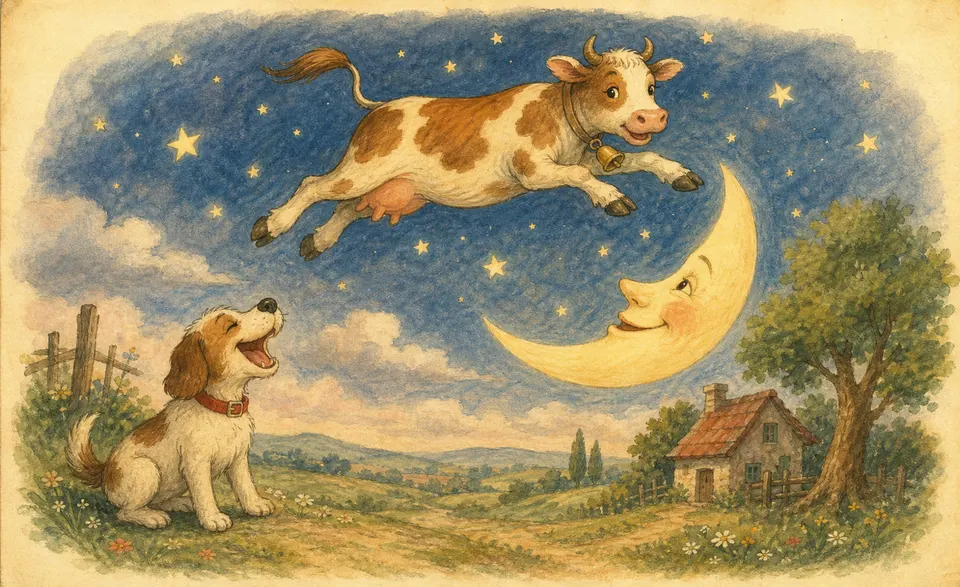
Hey diddle diddle, the cat and the fiddle, The cow jumped over the moon. The little dog laughed to see such fun, And the dish ran away with the spoon!
#Hey Diddle Diddle at a glance
- Country of origin
- 🇬🇧 United Kingdom
- Sung in
- English
- Words by
- Traditional
- First known
- c. 1765
- Best for ages
- 2–7
- Mood
- playful, traditional
- Last updated
- 25 July 2026
Meaning and origin
This is nonsense, and gloriously so. In four lines a cat plays a fiddle, a cow clears the moon in a single jump, a dog laughs out loud, and the tableware elopes — a run of cheerful impossibilities that a small child accepts without the slightest trouble. Scholars have concluded what children already know: it is literary nonsense, meant to delight rather than to mean.
That has not stopped people trying to decode it. Over the years the rhyme has been tied to ancient Greek choruses, to figures at the Tudor court, and even to an arrangement of constellations — every reading unsupported, and the whole industry of guesses once quietly satirised by J. R. R. Tolkien. About the only solid footnote is that “The Cat and the Fiddle” was a real inn name, recorded in London as early as 1587.
The rhyme is old — printed around 1765 in Mother Goose’s Melody — and it has left one lasting mark on English beyond the nursery. When we say someone is “over the moon” with happiness, we are quoting this cow.
Common questions
- What does "Hey Diddle Diddle" mean?
- Most scholars agree it means nothing in particular — it is nonsense verse, a string of impossible, delightful images: a fiddling cat, a cow jumping the moon, a laughing dog, a dish eloping with a spoon. The fun is precisely that none of it makes sense.
- How old is the rhyme?
- The earliest recorded version close to the modern one was printed in London around 1765 in "Mother Goose's Melody". The melody usually sung was written down later, by James William Elliott in 1870.
- Did the phrase "over the moon" come from this rhyme?
- Yes. The expression "over the moon", meaning delighted or thrilled, comes from the cow that jumped over the moon in this very rhyme.
- Have people tried to find a hidden meaning?
- Many have — proposing links to Greek choruses, Tudor courtiers, even constellations — but all of it is guesswork with no evidence, and the flood of theories was gently mocked by J. R. R. Tolkien. "The Cat and the Fiddle" was, at least, a genuine old English inn name, recorded in London by 1587.