Lyrics
Der vollständige Liedtext von „Häschen in der Grube“ mit englischer Übersetzung.
Häschen in der Grube sitzt und schläft, sitzt und schläft. Armes Häschen, bist du krank, dass du nicht mehr hüpfen kannst? Häschen hüpf! Häschen hüpf! Häschen hüpf!
#English translation
Little rabbit in its hollow sits and sleeps, sits and sleeps. Poor little rabbit, are you ill, that you can hop no more? Little rabbit, hop! Little rabbit, hop! Little rabbit, hop!
#Häschen in der Grube at a glance
- Country of origin
- 🇩🇪 Germany
- Sung in
- German
- Words by
- Friedrich Fröbel
- First known
- 1840
- Best for ages
- 2–7
- Mood
- playful, traditional
- Last updated
- 27 August 2026
How to sing it
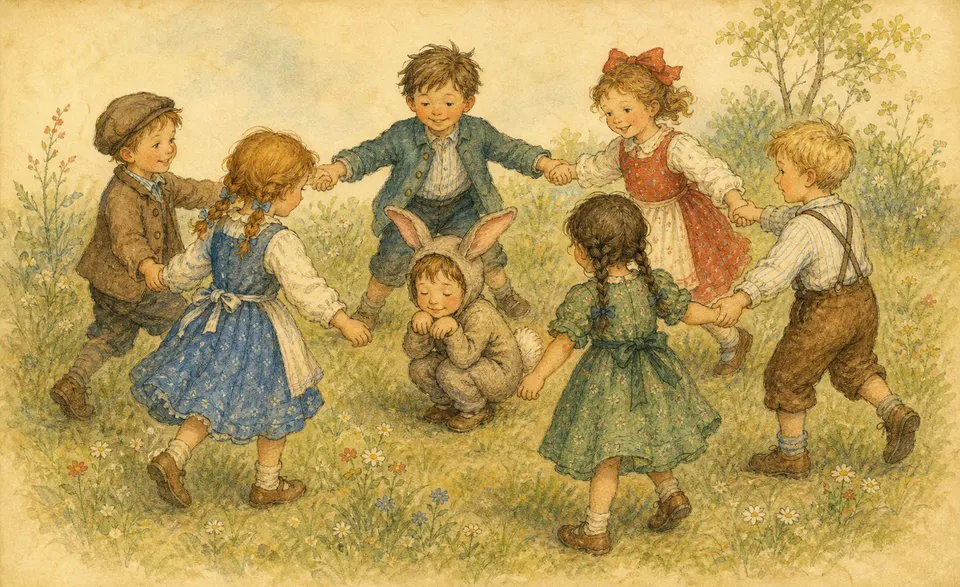
- One child crouches in the middle as the sleeping "little rabbit"; the others join hands and circle around.
- Sing the first lines slowly while the rabbit pretends to sleep in its hollow.
- On "Häschen hüpf!" the rabbit springs up and hops out, and everyone hops — then a new rabbit is chosen.
Meaning and origin
This is a game before it is a song. One child curls up in the middle as a little rabbit fast asleep in its hollow, while the others join hands and circle around, singing. They coax the drowsy creature — poor little rabbit, are you ill, that you can’t hop any more? — until, on the command “Häschen hüpf!”, the rabbit springs up and hops away and every child hops with it. Then a new rabbit is chosen and it begins again.
Unusually for a nursery song, we know exactly who made it. The words were written in 1840 by Friedrich Fröbel — the educator who invented the kindergarten — at Keilhau in Thuringia, as one of the movement games through which he believed young children learn best. Within two years it had entered the training of kindergarten teachers, and from there it spread across the German-speaking world.
Fröbel did not need a new tune: he set his words to a melody adapted from the folk song “Wer die Gans gestohlen hat, der ist ein Dieb” — the tune Ernst Anschütz had already fitted with new words in 1824 as “Fuchs, du hast die Gans gestohlen”. So the rabbit hops to a borrowed melody — an old tune given a new game — which is perhaps why it has always felt as familiar as if it had been sung forever.
Common questions
- What is "Häschen in der Grube"?
- A singing circle game. A little rabbit sits sleeping in its hollow, and the children ask, "Poor little rabbit, are you ill, that you can't hop any more?" — then call "Little rabbit, hop!" until it springs up and hops away. One child usually plays the rabbit in the middle while the others circle around.
- Who wrote "Häschen in der Grube"?
- The words were written in 1840 by Friedrich Fröbel, the German educator who founded the kindergarten, at Keilhau. He created it as a movement game for young children, and by 1842 it was being used in the training of kindergarten teachers.
- Where does the melody come from?
- The tune is adapted from the folk song "Wer die Gans gestohlen hat, der ist ein Dieb" — the same tune that Ernst Anschütz had given new words in 1824 as "Fuchs, du hast die Gans gestohlen".