Lyrics
Celotno besedilo pesmi »En hud pesjan je živel« z angleškim prevodom.
En hud pesjan je živel, se futral je z ljudmi, z njih žup'co si je kuhal, obral jih do kosti.
#Enkrat pa en'ga najde, ga hoče v lonec dat', preveč je čudno dišal, preveč je bil kosmat.
#Kdo bil je ta kosmatež, lahko ugane vsak. Dihur je bil, kajneda! Narobe, bil je vrag!
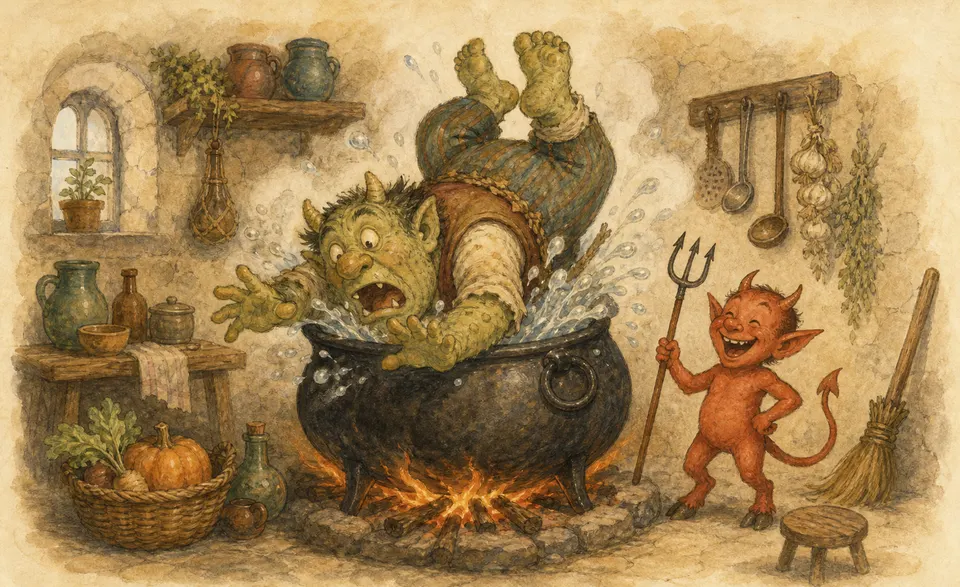
#Pesjan čez kotel padu, pa s kropom se polil, ga vrag je brž obglodal, pa župco vso popil.
#Uči nas tale štor'ja, da kjer sta vraga dva, da tisti zmerom zmaga, k' 'ma več pesjanskega.
#English translation
A fierce ogre once lived, he fed himself on people, cooked soup out of them, picked them clean to the bone. But once he catches one he means to put in the pot — it smelled far too strange, it was far too hairy. Who was this hairy thing? Anyone can guess. A polecat, surely? — No! It was the Devil! The ogre fell over the cauldron, scalded himself with boiling water; the Devil quickly gnawed him up, and drank up all the soup. This little story teaches us that where there are two fiends, the one always wins who has more of the beast in him.
#Rights
The words of this song are by Mirko Mahnič and are still in copyright. They are reproduced here, credited, for family and classroom singing; no reuse licence has been obtained, and nothing on this page may be copied further. Rightsholders can ask for a correction or removal — see lyrics & credits.
En hud pesjan je živel at a glance
- Country of origin
- 🇸🇮 Slovenia
- Sung in
- Slovenian
- Words by
- Mirko Mahnič
- First known
- Words credited to Mirko Mahnič; sung as "Pesjanska" in the 1971 TV serial "Erazem in potepuh", with music attributed to Marijan Vodopivec
- Best for ages
- 2–7
- Mood
- playful, traditional
- Last updated
- 27 August 2026
Meaning and origin
This is one of the odder corners of the Slovenian nursery — a darkly comic song in the old tradition of grisly tales told for laughs. A fierce ogre lives by eating people, cooking soup from them and picking them to the bone, until the day he catches something to cook that smells too strange and looks too hairy. The punchline of the middle verse is that his intended dinner is not a polecat, as you might guess, but the Devil himself — and the tables turn at once: the ogre topples into his own boiling cauldron, and the Devil gnaws him up and drinks the soup.
For all its cannibals and cauldrons, it plays as cartoonish comedy: the villain is out-monstered and served exactly what he had coming, and the whole thing ends on a mock-solemn moral — where two fiends meet, the beastlier one always wins.
It is not an old folk song, though it is often filed as one. It was sung, as Pesjanska, in Erazem in potepuh, the 1971 RTV Ljubljana children’s serial based on Astrid Lindgren’s Rasmus, where the actor Dare Ulaga performed it; the song was issued on a small record alongside Huda mravljica and Sirota Jerica from the same serial. The lyrics site Besedilo.si credits both the words and the music to Mirko Mahnič (1919–2018) — a theatre director, writer and for many years the language coach at the Ljubljana Drama — while the music is elsewhere attributed to Marijan Vodopivec, whose list of film and radio scores includes Pesjanska. The words, then, are Mahnič’s and the tune most likely Vodopivec’s. The folk-song site that prints the text names no author at all, and the song is sometimes miscredited to Janez Bitenc — we found nothing to support that. Its sly, unsqueamish humour is of a piece with the older children’s songs that were never expected to be entirely gentle.
Common questions
- What is "En hud pesjan je živel" about?
- A comic tale of poetic justice. A fierce ogre lives by eating people — cooking soup from them and picking them to the bone. One day he catches a strange, hairy creature to cook, but it turns out to be the Devil; the ogre tumbles into his own cauldron of boiling water, and the Devil gobbles him up and drinks all the soup. The mock-moral: where two fiends meet, the beastlier one always wins.
- Is "En hud pesjan je živel" too scary for children?
- It is grisly on paper, but plays as broad, cartoonish comedy — an ogre out-monstered by the Devil and served his just deserts. Like many old comic tales, the horror is exaggerated for laughs, and the villain, not any innocent, comes to a sticky end.
- Who wrote "En hud pesjan je živel"?
- The lyrics site Besedilo.si credits both words and music to Mirko Mahnič (1919–2018), a theatre director, writer and long-time language coach at the Ljubljana Drama. The song was sung — under the title "Pesjanska" — in the 1971 RTV Ljubljana children's serial "Erazem in potepuh", performed by the actor Dare Ulaga, and the music there is attributed to the composer Marijan Vodopivec: Slovenian Wikipedia lists "Pesjanska" among his film and radio scores, and a record collector's account of the 1971 single says the same. So the words are Mahnič's and the tune is most likely Vodopivec's. The folk-song site that prints the text names no author, and it is sometimes miscredited to Janez Bitenc, for which we found no source.
Sources
- Slovenske narodne pesmi — En hud pesjan je živel (text as printed here)
- Besedilo.si — En hud pesjan je živel (credits words and music to Mirko Mahnič)
- Wikipedija — Marijan Vodopivec (lists "Pesjanska" among his film and radio music)
- Iztok Gartner — the 1971 "Erazem in potepuh" record: Huda mravljica, Pesjanska, Sirota Jerica
- RTV Slovenija — obituary of Mirko Mahnič (2018)