Lyrics
Celotno besedilo pesmi »Ekate, pekate, cukate me« z angleškim prevodom.
Ekate pekate cukate me, fibe fabe domine, ektum pektum kufr štuc, kvinte kvante fingo puc.
#English translation
English note
Ekate pekate cukate me, fibe fabe domine, ektum pektum kufr štuc, kvinte kvante fingo puc. (nonsense counting-out syllables with no fixed meaning; chanted for the rhythm)
#Ekate, pekate, cukate me at a glance
- Country of origin
- 🇸🇮 Slovenia
- Sung in
- Slovenian
- Words by
- Traditional
- First known
- traditional counting-out rhyme; origin not documented
- Best for ages
- 2–7
- Mood
- playful, traditional
- Last updated
- 27 August 2026
How to sing it
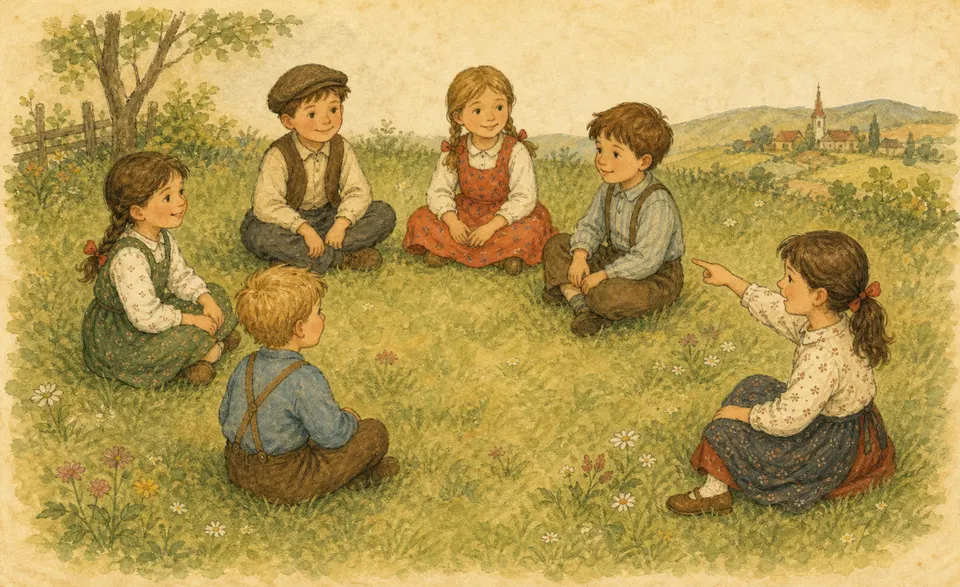
- Stand in a circle and point to a different child on each word or syllable.
- Chant it briskly, right around the ring.
- Whoever the last word lands on is "it" (or is out) — then play the game.
Meaning and origin
This is a Slovenian counting-out rhyme — an izštevanka — and it is almost pure sound. Children chant it while pointing around a circle, one child per beat, and whoever the last word falls on is chosen: to be “it”, or to be out, before a game begins. It does exactly the job that “eeny, meeny, miny, moe” does for English-speaking children, in exactly the same way.
Its words are nonsense. The collections that print it give no meaning for them, and none is needed: a counting-out rhyme needs a strong, steady beat far more than it needs sense, so the syllables are chosen to trip nicely off the tongue. Because it lives in the mouth rather than on the page, the wording drifts — parents recalling it online produce “kufer štuc” for “kufr štuc”, or an ending “kvinte kvante ti si fuč”, “you’re out”, which makes the elimination explicit.
Nobody wrote it, or at least nobody’s name has stuck to it, and we found no record of where or when it began. Rhymes like this are pure playground tradition, passed from child to child and useful in the one way that matters — fairly, and with a bit of ceremony, deciding who goes first.
Common questions
- What is "Ekate, pekate, cukate me"?
- A counting-out rhyme — in Slovenian, an "izštevanka". Children chant it while pointing round a circle, one person per word, and whoever the last word lands on is chosen (to be "it", or to be out). It does for Slovenian children what "eeny, meeny, miny, moe" does for English-speaking ones.
- What do the words mean?
- Nothing that anyone has pinned down: they are nonsense syllables, chanted for their beat rather than their sense, and the sources that print the rhyme offer no meaning for them. The steady rhythm is what matters for counting out. The wording also shifts from family to family — some remember "kufer štuc" or an ending "ti si fuč" ("you're out").
- Who wrote "Ekate, pekate, cukate me"?
- No one knows, and no source we found records where or when it started. Counting-out rhymes like this are oral playground tradition, passed from child to child, which is why they survive in several variants.