Lyrics
Der vollständige Liedtext von „Zug, Zug, Zug, die Eisenbahn“ mit englischer Übersetzung.
Zug, Zug, Zug, die Eisenbahn, wer will mit nach Herne fahren? Herne ist 'ne schöne Stadt, die so tolle Kinder hat.
#English translation
Train, train, train, the railway, who wants to ride to Herne? Herne is a lovely town, that has such wonderful children.
#Zug, Zug, Zug, die Eisenbahn at a glance
- Country of origin
- 🇩🇪 Germany
- Sung in
- German
- Words by
- Traditional
- First known
- traditional children's song; author unknown
- Best for ages
- 2–7
- Mood
- dancing, playful
- Last updated
- 25 July 2026
Meaning and origin
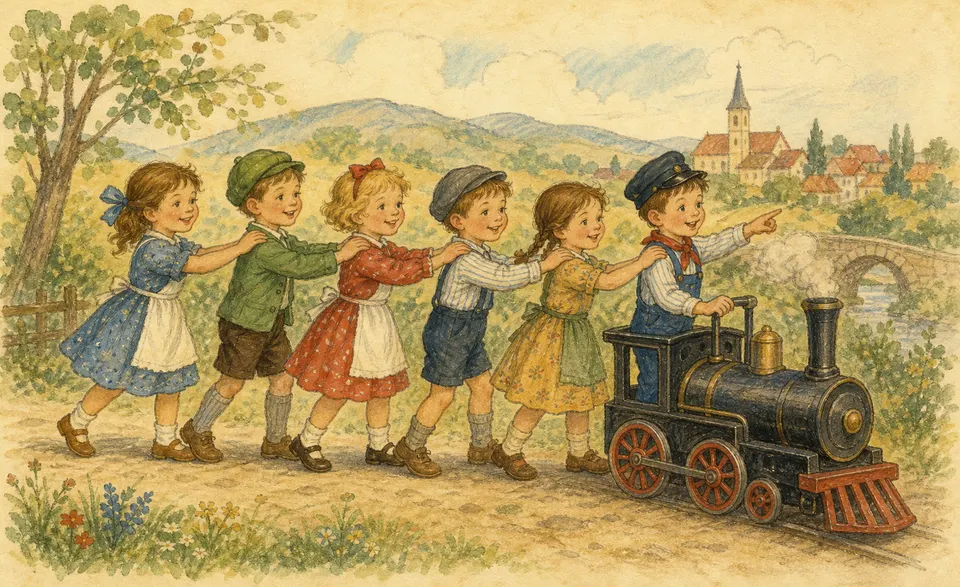
This is a tiny train song, made for moving rather than for sitting still. Children line up one behind the other, hands on the shoulders in front, and chug around the room like the carriages of a locomotive while they sing: all aboard, who wants to ride to Herne? — Herne being a real town in Germany’s Ruhr region, praised in the last lines for its wonderful children.
That place-name is really a blank to be filled in. Songs like this one belong to whatever town sings them, so the “Herne” here would simply become the name of the local place elsewhere. No author is recorded for it — it is a traditional bit of kindergarten fun whose whole purpose is to get a line of children chugging happily around the room.
Common questions
- What is "Zug, Zug, Zug, die Eisenbahn" about?
- A train ride. It calls out for the railway — "who wants to ride to Herne?" — and praises the destination as a lovely town with such wonderful children in it. In this version the town named is Herne, in Germany's Ruhr region.
- Why Herne?
- Because place-names in this kind of song are swapped for the local town. "Herne" here simply makes it a local song for children there; sung elsewhere, the last lines would name another town instead.
- How is "Zug, Zug, Zug, die Eisenbahn" played?
- As a movement game. Children usually line up one behind another with hands on the shoulders in front, then chug around the room like the carriages of a train while they sing.