Lyrics
Celotno besedilo pesmi »Živali v jeseni« z angleškim prevodom.
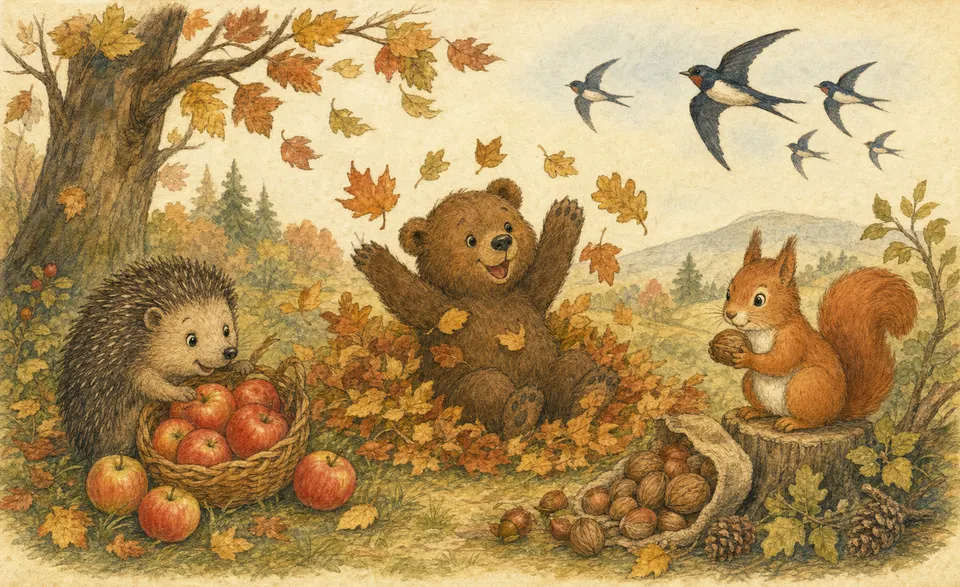
Ježek teka, teka in se kotali, jabolka in hruške nabadati hiti.
#Medved kosmatinec svoj brlog ravna, z listjem si postilja, zaspano godrnja.
#Urna veverica pleza na drevo, lešnike nabira za zimsko lakoto.
#Ptice lastovice odletele so, v daljne tople kraje zdaj jih krila nesejo.
#English translation
The hedgehog runs and runs and rolls himself along, hurrying to spear apples and pears. The shaggy bear tidies his den, beds himself with leaves, grumbling sleepily. The nimble squirrel climbs up the tree, gathering hazelnuts against winter hunger. The swallow birds have flown away, to far-off warm lands now their wings carry them.
#Rights
The words of this song are by Mira Voglar and are still in copyright. They are reproduced here, credited, for family and classroom singing; no reuse licence has been obtained, and nothing on this page may be copied further. Rightsholders can ask for a correction or removal — see lyrics & credits.
Živali v jeseni at a glance
- Country of origin
- 🇸🇮 Slovenia
- Sung in
- Slovenian
- Words by
- Mira Voglar
- First known
- Credited to Mira Voglar (1935–2026) by the cited kindergarten song sheet, which does not separate words and music
- Best for ages
- 2–7
- Mood
- seasonal, playful
- Last updated
- 27 August 2026
Meaning and origin
This is a nature lesson turned into a song, and a lovely one. Each verse takes a single animal and shows how it readies itself for winter: the hedgehog runs and rolls about, hurrying to spear apples and pears on his spines; the shaggy bear tidies his den, beds it with leaves and grumbles sleepily toward hibernation; the nimble squirrel climbs the tree to store hazelnuts against the winter hunger; and the swallows have flown off to far-off warm lands on their carrying wings. Four animals, four different answers to the coming cold.
Its quiet cleverness is that it teaches real natural history — gathering food, making a warm den, hibernating, migrating — without ever sounding like a lesson, by tying each behaviour to an animal a child already loves. That is very much the work Mira Voglar (1935–2026) is remembered for: RTV Slovenija’s obituary calls her a pioneer of preschool music education in Slovenia, and 24ur.com lists “Biba, Buba, Baja”, “Kahlica Bahlica” and “Sij, sončece, sij” among her best-known publications. Our source, a song sheet from a Grosuplje kindergarten, prints this one as “Živali jeseni (M. Voglar)” without separating words and music, and we have kept the attribution as given. Voglar died in July 2026, so her work remains in copyright.
Common questions
- What is "Živali v jeseni" about?
- How animals get ready for winter. The hedgehog runs about and rolls, hurrying to spear apples and pears on his spines; the shaggy bear tidies his den, beds it with leaves and grumbles sleepily; the nimble squirrel climbs the tree to store hazelnuts against winter hunger; and the swallows have flown away to far-off warm lands, their wings carrying them. Each verse is one animal's autumn preparation.
- What does "Živali v jeseni" teach?
- A gentle first lesson in nature and the seasons — how different animals respond to the coming cold (gathering food, making a warm den, hibernating, migrating). It pairs each behaviour with a familiar animal so children can remember it.
- Who wrote "Živali v jeseni"?
- It is credited to Mira Voglar (1935–2026), the Slovenian composer and music educator whom RTV Slovenija describes as a pioneer of preschool music education in Slovenia. Our source, a song sheet from the VVZ Kekec Grosuplje kindergarten, prints it as "Živali jeseni (M. Voglar)" without saying whether she wrote the words as well as the music, and we have kept the attribution as given. Voglar was born in Ravne na Koroškem in 1935 and died in July 2026; her work is still in copyright.