Lyrics
La letra completa de «Un elefante se balanceaba» con traducción al inglés.
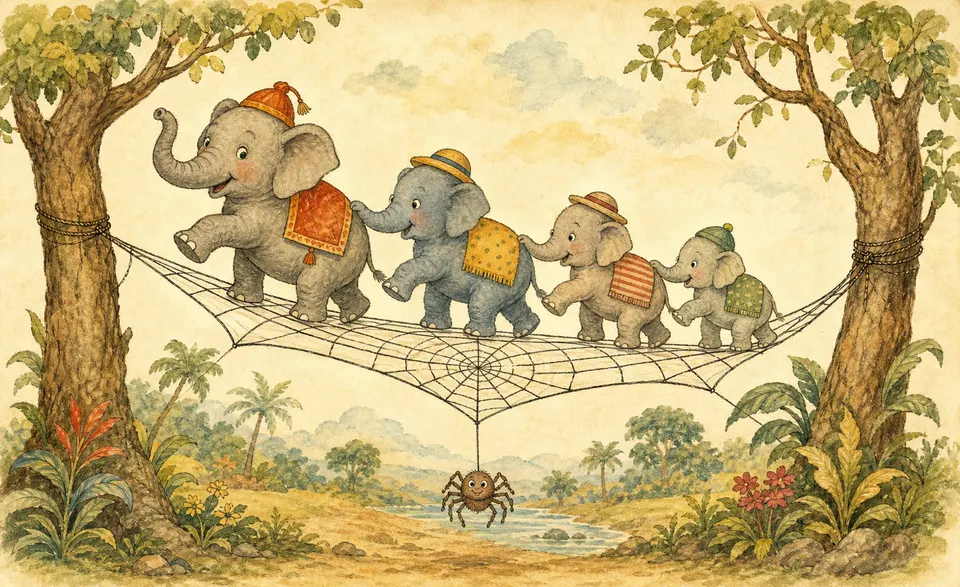
Un elefante se balanceaba sobre la tela de una araña. Como veía que resistía, fue a llamar a otro elefante.
#Dos elefantes se balanceaban sobre la tela de una araña. Como veían que resistía, fueron a llamar a otro elefante.
#English translation
One elephant was balancing on the thread of a spider's web. And since it held his weight just fine, he went and called another elephant.
#Un elefante se balanceaba at a glance
- Country of origin
- 🌐 Unknown
- Sung in
- Spanish
- Words by
- Traditional
- First known
- Origin undocumented; Mama Lisa's World notes a song with the same opening lines printed in France in the mid-19th century
- Best for ages
- 2–6
- Mood
- counting, playful
- Last updated
- 24 July 2026
How to sing it
- Hold up one finger for the first elephant and add a finger each verse.
- Sway slowly side to side on "se balanceaba" — the whole song is a balancing act.
- Let a different child call out the new number at the start of each verse.
- Keep adding elephants until somebody loses count; the song has no written ending.
Meaning and origin
The premise is absurd and the children singing it know exactly how absurd it is: an elephant is standing on a spider’s web, the web holds, and so the elephant decides the sensible next step is to invite a friend.
Structurally this is a cumulative song, one of the oldest and most useful shapes in children’s music. The verse never changes except for the number, which climbs by one each time. That repetition is doing real work. Because the melody, the rhythm and every other word stay identical, a very small child has only one thing to track — the count — and gets to hear, over and over, that four comes after three and that each new number is simply the last one plus another elephant.
It has no ending, and that is deliberate. There is no final verse where the web breaks or the elephants fall, which means the song lasts exactly as long as everyone’s patience and arithmetic hold out. Some families stop at five, some grind on into the teens, and the collapse of the count is usually funnier than any written ending would be.
The song travels widely and its origin is not documented. Mama Lisa’s World prints Spanish-language versions from Mexico, Colombia, Puerto Rico and Spain — the Spanish one has the elephant call a friend “como veía que no se caía”, because he saw he wasn’t falling, where the Mexican text on this page has “como veía que resistía” — and relatives in French, Italian, Romanian, German, the Nordic languages and English. The same site notes that a song with the same opening lines appeared in print in France in the mid-nineteenth century, but that nobody knows for certain where the children’s song and its many versions come from. So the page gives no country: all the versions keep the picture that makes the song work — something enormously heavy resting on something almost impossibly fine, and holding — but none of them can say where it was first drawn.
Common questions
- What does "Un elefante se balanceaba" mean in English?
- "One elephant was balancing" — on a spider's web. Seeing that the web held his weight, he calls another elephant to join him, and each verse adds one more.
- How many verses does the elephant song have?
- As many as the singers can manage. It is a cumulative song with no fixed ending: the count rises by one each time, and families usually stop somewhere between five and ten, or whenever the counting collapses.
- What does "Un elefante se balanceaba" teach children?
- Counting upward one at a time, and the idea that each number is the previous one plus one. Because the number changes but the tune does not, children can concentrate on the count while the melody carries them.
- Which countries sing "Un elefante se balanceaba", and where does it come from?
- Mama Lisa's World collects Spanish-language versions from Mexico, Colombia, Puerto Rico and Spain, alongside relatives in French ("Un éléphant se balançait"), Italian, Romanian, German, Danish, Norwegian, Swedish, Finnish, Icelandic and English ("One Elephant Went Out to Play"). The Mexican text — the one on this page — says "como veía que resistía, fue a llamar a otro elefante"; the Spanish one says "como veía que no se caía, llamó a otro elefante". Where the song began is not documented: Mama Lisa's World notes that a song with the same opening lines was printed in France in the mid-19th century, but that nobody knows for certain where the children's song and its versions come from. That is why no country is given here.