Lyrics
1931 “Pufferbilly Song” verse
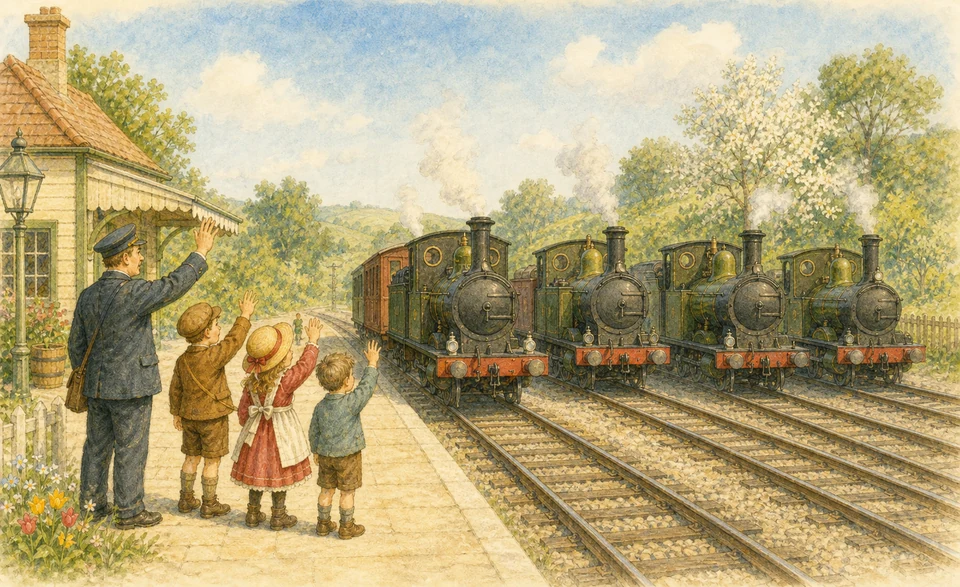
Down at the station, early in the morning, See the little pufferbillies standing in a row. See the engine driver twist the little handle, Tst! Tst! Toot! Toot! There they go.
#Down by the Station at a glance
- Country of origin
- 🌐 Unknown
- Sung in
- English
- Words by
- Traditional
- First known
- 1931 “Pufferbilly Song”; 1948 Ricks–Gaillard sheet-music version
- Best for ages
- 2–6
- Mood
- playful, educational
- Last updated
- 24 August 2026
How to sing it
- Begin slowly so everyone can hear the repeated words and the action cue.
- Line up like engines, turn an imaginary handle, release two soft steam sounds, then make two whistle sounds and move forward.
- Repeat the song once and invite a different child to lead the cues.
Meaning and origin
The song begins as an observation: small steam engines are standing in a row early in the morning. The final line turns the scene into sound. “Puff” imitates escaping steam, “toot” imitates the whistle, and the engines move off. The older word “Pufferbilly” works as a playful name for those little locomotives, so even a child who does not know the word can understand it from the sounds and actions around it.
The earliest text used for this page is the four-line “Pufferbilly Song” printed in Recreation magazine in 1931. A University of Rochester catalogue also records a 1948 sheet-music version associated with Lee Ricks and Slim Gaillard. That later publication added material, but it does not make Ricks and Gaillard the authors of the anonymous 1931 verse; this page therefore keeps to the earlier four-line form rather than silently combining the two.
Its structure makes the song easy to turn into group play. Children can stand in a row like engines, turn an imaginary handle with the driver, release two soft bursts of steam and answer them with two whistle sounds. The sequence gives every singer a cue to listen for, and the whole line can then move forward together on “off we go.”
Common questions
- What does “Pufferbilly” mean in Down by the Station?
- The 1931 “Pufferbilly Song” uses “Pufferbillies” as a playful name for the small steam engines waiting in a row. Its “Tst! Tst! Toot! Toot!” ending imitates escaping steam and a train whistle.
- Did Lee Ricks and Slim Gaillard write the verse shown here?
- No named author was found for the four-line verse printed in 1931. A 1948 Ricks–Gaillard sheet-music version added material, but this page does not reproduce that later addition.