LyricsHistorical print version (Rackham, 1913)
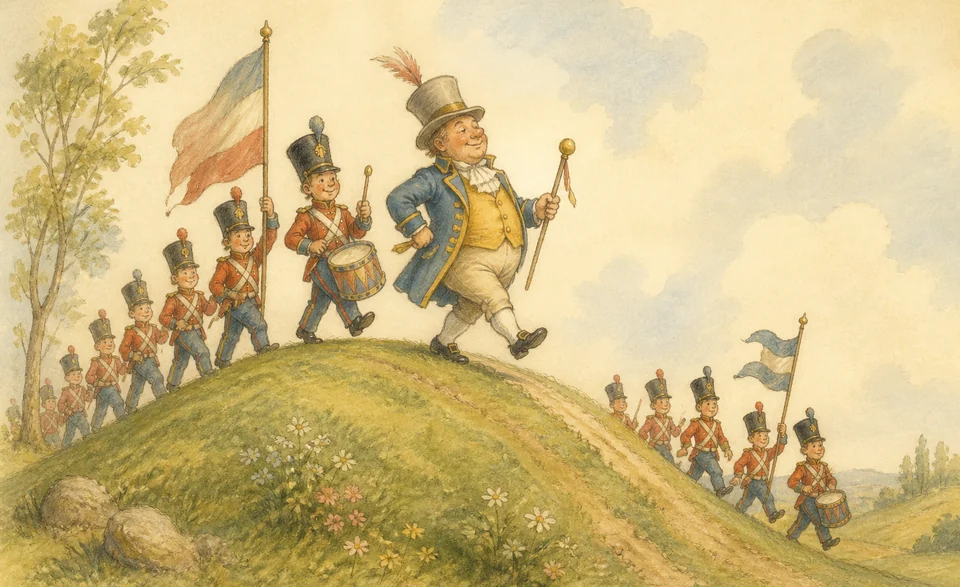
O, the grand old Duke of York, He had ten thousand men; He marched them up a great big hill, And he marched them down again! So when they were up, they were up, And when they were down, they were down; And when they were neither down nor up, They were neither up nor down.
#LyricsSupplied modern marching version
Oh, the grand old Duke of York, He had ten thousand men; He marched them up to the top of the hill, And he marched them down again. And when they were up, they were up, And when they were down, they were down; And when they were only halfway up, They were neither up nor down. They all marched up to the top of the hill, With a hup, two, three, four, drilling their drill. Oh, the grand old Duke of York, He had ten thousand men; He marched them up to the top of the hill, And he marched them down again. And when they were up, they were up, And when they were down, they were down; And when they were only halfway up, They were neither up nor down.
#The Grand Old Duke of York at a glance
- Country of origin
- 🌐 Unknown
- Sung in
- English
- Words by
- Traditional
- First known
- 1913 (familiar Duke of York version)
- Best for ages
- 2–7
- Mood
- playful, traditional, dancing
- Last updated
- 23 August 2026
How to sing it
- March in place with a steady beat through the first stanza.
- Stand tall on every “up”, crouch on every “down”, and stop halfway on “neither” before the final movement.
Meaning and origin
The familiar Duke of York text appears in Arthur Rackham’s 1913 Mother Goose. Its joke is entirely physical: a large army is marched up a hill and back down without accomplishing anything, then the second stanza turns those directions into a rapid movement game.
The idea is older than the named duke. Frederica Seeger’s game book (undated in the Project Gutenberg edition) prints a related rhyme about the King of France marching forty thousand men up a hill and down again, and the Traditional Ballad Index dates the earliest collection of the Duke of York rhyme itself to 1892, with versions recorded in England, Scotland, Ireland and the United States. That precursor makes it unsafe to identify the title character with any one historical Duke of York, and none of the sources consulted settles where the rhyme began, so no country of origin is given.
The first panel keeps Rackham’s documented wording. The supplied marching sequence appears separately, including the supplied count “hup, two, three, four” and its repeated ending, so the addition is visible rather than being attributed to the 1913 source.
Common questions
- Which Duke of York is the song about?
- The lyric does not identify one, and attempts to match it to a particular historical duke remain speculative; the Traditional Ballad Index discusses Frederick, Duke of York (1763–1827), as the leading candidate. Older related rhymes name the King of France instead.
- Are “hup, two, three, four” part of the old words?
- Those marching calls are a useful modern addition, but they do not appear in the 1913 text used on this page.
- Why are there two lyric versions?
- The first panel is the documented 1913 wording. The second preserves the supplied modern marching sequence, including the later “hup, two, three, four” line and its repeated ending.