Lyrics
Common current ending
A, B, C, D, E, F, G, H, I, J, K, L, M, N, O, P, Q, R, S, T, U, V, W, X, Y and Z. Now I know my A, B, Cs, Next time won’t you sing with me?
#1915 printed ending
A, B, C, D, E, F, G, H, I, J, K, L, M, N, O, P, Q, R, S, T, U, V, W, X, Y and Z. Now I’ve said my A, B, C, Tell me what you think of me.
#The Alphabet Song (ABC Song) at a glance
- Country of origin
- 🇺🇸 United States
- Sung in
- English
- Words by
- Traditional
- First known
- 1835 publication; displayed historical ending printed in 1915
- Best for ages
- 2–6
- Mood
- educational, playful, traditional
- Last updated
- 27 August 2026
How to sing it
- Begin slowly so everyone can hear the repeated words and the action cue.
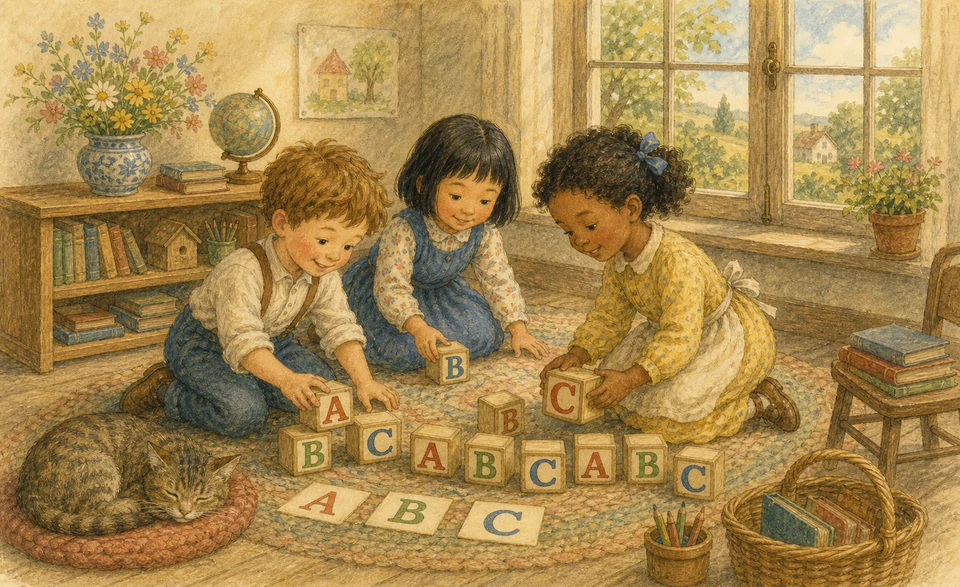
- Point to each printed letter while singing and slow slightly through L–M–N–O–P so every name stays distinct.
- Repeat the song once and invite a different child to lead the cues.
Meaning and origin
The song gives the names of the English alphabet in a fixed order and lets melody carry a sequence that would otherwise be an abstract list. Its trickiest stretch is L–M–N–O–P, where several short letter names share a quick run of notes. Slowing that phrase and pointing to printed letters keeps the sounds distinct instead of letting them blur into one invented word.
An American sheet titled “A.B.C.” was published in Boston in 1835, setting the alphabet to a melody that already existed in Europe. That publication documents an important English-language form, but it does not prove that one person created both the letter text and the tune. The closing couplet has also varied. This page separates the common modern ending from the ending printed in the cited 1915 collection — “Now I’ve said my A, B, C, / Tell me what you think of me” — rather than presenting both as one timeless fixed text.
For learning, the useful action is precise rather than elaborate. Point to each uppercase or lowercase letter as its name is sung, pause between repeated rounds and give extra space to the rapid middle group. Children can then take turns pointing while the rest sing, linking the remembered sound sequence to the visible written order.
Common questions
- Who wrote The Alphabet Song?
- An American “A.B.C.” sheet was published in Boston in 1835 using an already existing European melody. The evidence supports that publication history, but not a claim that one person created both the alphabet words and the tune.
- Why does The Alphabet Song have different endings?
- Closing lines have changed between printings and present-day singing. This page keeps the common modern ending (“Now I know my A, B, Cs”) separate from the ending printed in the 1915 Volland Mother Goose: “Now I’ve said my A, B, C, / Tell me what you think of me.”