Lyrics
De volledige songtekst van "Sinterklaas Kapoentje" met Engelse vertaling.
Sinterklaas Kapoentje, gooi wat in mijn schoentje, gooi wat in mijn laarsje, dank u, Sinterklaasje!
#English translation
Saint Nicholas, dear kapoentje, throw something into my little shoe, throw something into my little boot, thank you, dear Saint Nicholas!
#Sinterklaas Kapoentje at a glance
- Country of origin
- 🇳🇱 Netherlands
- Sung in
- Dutch
- Words by
- Traditional
- First known
- in print 1851 (possibly older)
- Best for ages
- 2–7
- Mood
- playful, traditional
- Last updated
- 27 August 2026
Meaning and origin
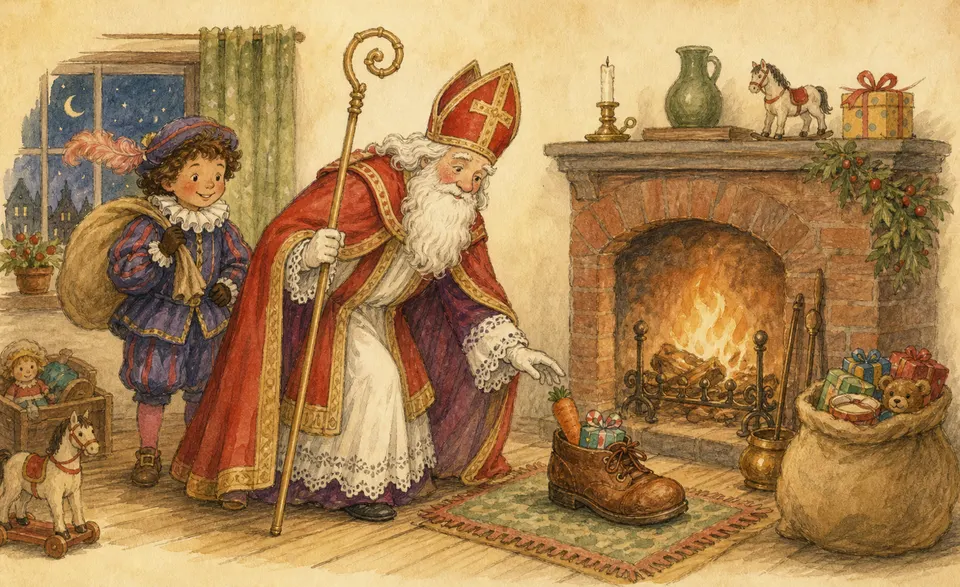
This tiny song sits at the heart of one of the Netherlands’ warmest traditions. During the Sinterklaas season, Dutch children set out a shoe — by the hearth, or the back door — in the hope that Saint Nicholas will drop a small treat inside overnight. “Sinterklaas Kapoentje” is the polite little bargain that goes with it: throw something into my shoe, throw something into my boot, and thank you, dear Saint. In four short lines it captures the whole delicious hopefulness of the custom.
It is genuinely old. It was already in print in 1851, in the journal De Navorscher, and may well have been sung long before that. The odd word kapoentje has puzzled people for just as long. The language society Onze Taal offers three explanations: a kapoen was originally a capon, a castrated cockerel — and a castrated man, which some link to the celibate bishop; it served for centuries as an insult for a rogue or scoundrel, softening over time until in Flanders it became an affectionate name for a mischievous child; and a nineteenth-century satirical-print character called Klaas Kapoen may have lent the Saint his nickname. None of that matters to the children, for whom the song is simply the spell you say over an empty shoe, and the delight is finding, next morning, that it worked.
Common questions
- What is "Sinterklaas Kapoentje" about?
- Setting out your shoe. Dutch children put a shoe by the fire (or door) during the Sinterklaas season, and this song is their little request: dear Saint Nicholas, throw something into my shoe, throw something into my boot — thank you! It is one of the shortest and best-known St Nicholas songs.
- How old is "Sinterklaas Kapoentje"?
- It is a folk song from the 19th century, first printed in the journal "De Navorscher" in 1851, and it may be older still. It has been sung at Sinterklaas (celebrated around 5–6 December) for generations.
- What does "kapoentje" mean?
- That is debated. A "kapoen" was originally a capon — a castrated cockerel — and also a castrated man, which some connect with the celibate bishop; it was long used as an insult meaning a rogue or scoundrel, and in Flanders it survives as an affectionate word for a mischievous child. A third explanation points to "Klaas Kapoen", a figure common in nineteenth-century satirical prints. The Dutch language society Onze Taal sets out all three without settling on one.