Lyrics
「Sakura Sakura」の歌詞と英語訳。
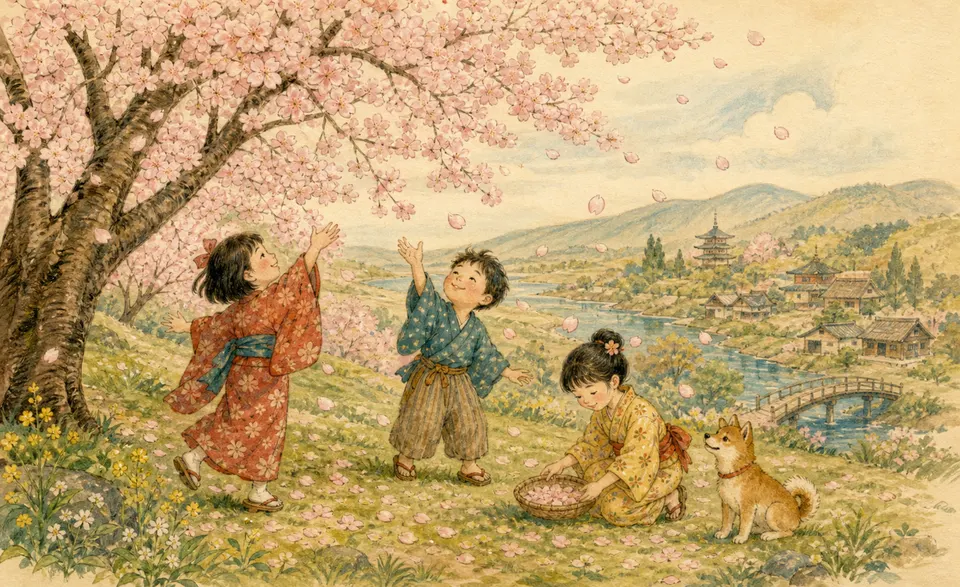
さくら さくら 野山も里も 見わたす限り かすみか雲か 朝日ににおう さくら さくら 花ざかり
#Romaji
Sakura, sakura, noyama mo sato mo miwatasu kagiri. Kasumi ka kumo ka, asahi ni niou. Sakura, sakura, hanazakari.
#English translation
Cherry blossoms, cherry blossoms, across fields and hills and villages, as far as the eye can see. Is it mist? Is it cloud? Fragrant in the morning sun. Cherry blossoms, cherry blossoms, in full bloom.
#Sakura Sakura at a glance
- Country of origin
- 🇯🇵 Japan
- Sung in
- Japanese
- Words by
- Traditional
- First known
- Edo period; published 1888
- Best for ages
- 3–10
- Mood
- seasonal, traditional, calming
- Last updated
- 24 July 2026
How to sing it
- Sing it slowly and evenly — this is a walking song, not a marching one.
- Let the two opening "sakura" calls hang, with a small pause after each.
- On "miwatasu kagiri" ("as far as the eye can see"), sweep one arm slowly across the horizon.
- Finish "hanazakari" softly, letting the last note fade rather than stopping it.
Meaning and origin
The whole song is one glance out of a window in spring. There is no story, no character and nothing that happens — only someone looking at cherry blossom so dense they cannot work out where flowers end and cloud begins, and saying so.
It is not ancient, and it did not begin as a folk song from the fields. It was a popular urban melody of the Edo period, and it was first printed in 1888, in the Collection of Japanese Koto Music issued by the Tokyo Academy of Music — a book of pieces for the koto, the long thirteen-stringed zither played flat on the floor; beginners on the koto still learn it early. (A separate Edo-period koto piece called Saita sakura also exists, and one theory holds that this melody began as a parody of it.) What was printed as a koto piece turned out to be the most recognisable tune in Japan. The lyric sung today was fixed in a Ministry of Education songbook in 1941, and the older text — beginning yayoi no sora wa, “the March sky” — was placed second there and is still occasionally heard instead.
Its unusual sound is not imagination. The melody uses the in scale, a five-note Japanese scale built with narrow half-step intervals that do not appear in a Western major or minor key. That is why a listener raised on European music hears it as unmistakably Japanese within about three notes, and why it turns up so often as musical shorthand for Japan in film and television.
For children it is a seasonal song, tied to a few weeks of the year. Blossom arrives, the song comes out, the petals fall, and it is put away until next spring — which is a large part of why it stays memorable. A song you can only sing for two weeks keeps its occasion attached to it for life.
Common questions
- What does Sakura Sakura mean?
- "Sakura" is the Japanese word for cherry blossom. The song describes blossom covering the fields, hills and villages as far as anyone can see, so thick that the singer cannot tell whether they are looking at flowers, mist or cloud.
- Is Sakura Sakura a children's song or a folk song?
- Both, depending on where you meet it. It was a popular urban melody of the Edo period, printed in 1888 in a koto collection used by beginners on the instrument; today it is sung by Japanese children and played by adult musicians alike.
- What scale is Sakura Sakura written in?
- It uses the in scale, a five-note Japanese scale with narrow half-step intervals. That is the source of its distinctive sound to Western ears — the melody moves in steps that a major or minor scale does not contain.
- Which words of Sakura Sakura are sung today?
- The verse most people know was published by the Ministry of Education in 1941 in the songbook "Uta no hon", where the older text — beginning "yayoi no sora wa", "the March sky" — was placed second. Both are still sung.