Lyrics
「Donguri Korokoro」の歌詞と英語訳。
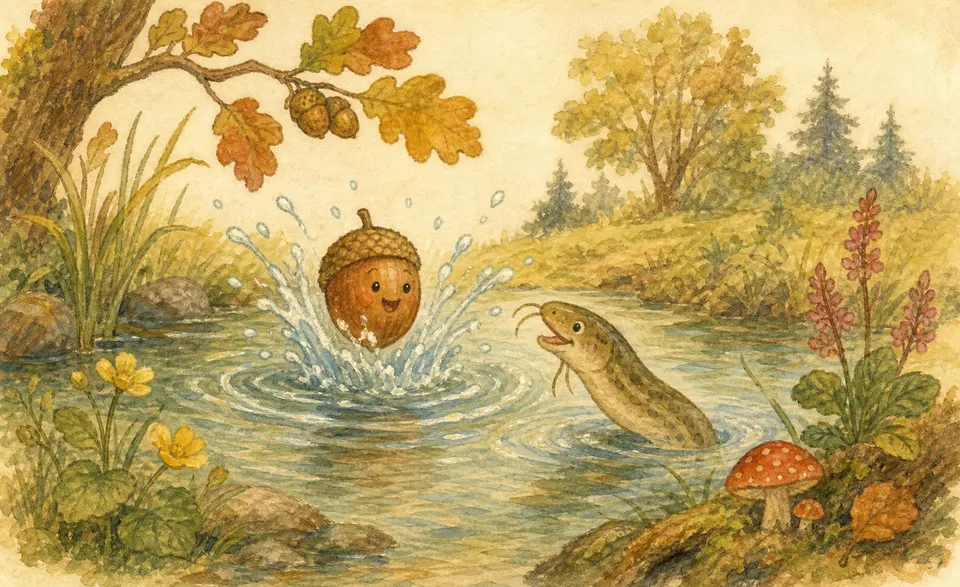
どんぐりころころ どんぶりこ お池にはまって さあ大変 どじょうが出て来て 今日は 坊ちゃん一緒に 遊びましょう
#Rōmaji
Donguri korokoro donburiko, oike ni hamatte saa taihen. Dojou ga detekite konnichiwa, bocchan issho ni asobimasho.
#English translation
An acorn rolls along and plops right in, it's fallen into the pond — oh, what a to-do! A loach comes swimming up: "Good day to you! Little young master, let's play together!"
#Donguri Korokoro at a glance
- Country of origin
- 🇯🇵 Japan
- Sung in
- Japanese
- Words by
- Aoki Nagayoshi
- First known
- 1921 or 1922
- Best for ages
- 2–7
- Mood
- playful, traditional
- Last updated
- 27 August 2026
Meaning and origin
This is one of the songs almost every Japanese child grows up singing, and it begins with a burst of pure sound: donguri korokoro donburiko — an acorn rolling, rolling, and plopping into a pond. Japanese is rich in these sound-and-motion words, and half the delight here is in saying them; korokoro is the very picture of something small tumbling along, and donburiko is the plump little splash it makes as it lands in the water.
What follows is a tiny drama. A loach — a small, whiskered fish that lives in the mud of ponds and paddies — swims up, greets the acorn politely, and invites it to play. In the song’s later verses the acorn, having had its fun, grows homesick for the mountain and begins to cry, which leaves the friendly loach at a loss for how to comfort it. It is a small lesson in how quickly delight can turn to longing.
Unlike the anonymous folk songs elsewhere in this collection, it has known authors: the words are by Aoki Nagayoshi (1879–1935) and the tune by Yanada Tadashi (1883–1959), first published in 1921 or 1922. More than a century on, it remains a fixture of Japanese childhood — proof that a whole world can be built from an acorn, a puddle and a couple of well-chosen sounds.
Common questions
- What is "Donguri Korokoro" about?
- An acorn's little adventure. The acorn rolls along — korokoro — and tumbles "donburiko" into a pond, which is quite a to-do. A loach (a small pond fish) swims up, says hello, and invites the acorn to play together. In the full song the acorn soon grows homesick and cries, which upsets the kindly loach.
- Who wrote "Donguri Korokoro", and when?
- The words were written by Aoki Nagayoshi (1879–1935) and the melody by Yanada Tadashi (1883–1959). It was first published in 1921 or 1922 and has been one of Japan's most popular children's songs ever since.
- What do "korokoro" and "donburiko" mean?
- They are sound-and-motion words, of which Japanese has many. "Korokoro" is the sound or picture of something small rolling along, and "donburiko" suggests a plump little splash into water — so the very first lines paint the acorn rolling and plopping into the pond.