Lyrics
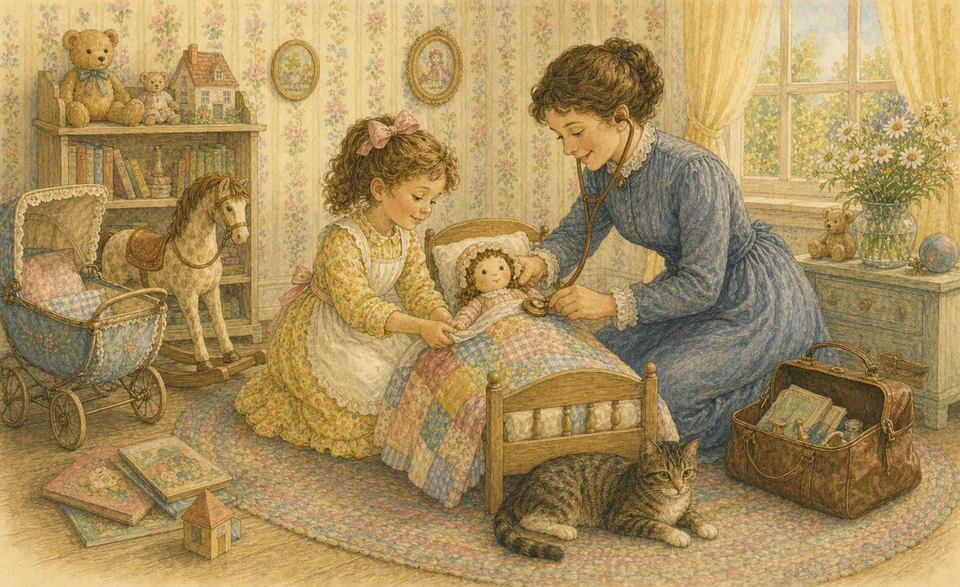
Miss Polly had a dolly who was sick, sick, sick, So she called for the doctor to come quick, quick, quick. The doctor came with his bag and his hat, And he knocked on the door with a rat-a-tat-tat. He looked at the dolly and he shook his head, He said, “Miss Polly, put her straight to bed, bed, bed.” He wrote on a paper for a pill, pill, pill, “I’ll be back in the morning with my bill, bill, bill.”
#Miss Polly Had a Dolly at a glance
- Country of origin
- 🌐 Unknown
- Sung in
- English
- Words by
- Traditional
- First known
- Recorded by 1964; earlier origin not established
- Best for ages
- 2–6
- Mood
- playful, educational
- Last updated
- 27 August 2026
How to sing it
- Begin slowly so everyone can hear the repeated words and the action cue.
- Rock a doll, mime a telephone, knock three times, examine the doll and pretend to write a prescription.
- Repeat the song once and invite a different child to lead the cues.
Meaning and origin
The rhyme compresses a complete doctor’s visit into a sequence that children can act out: a doll is ill, Miss Polly telephones for help, the doctor knocks, examines the patient, recommends bed and writes a prescription. Repeated words such as “sick, sick, sick” and “quick, quick, quick” mark the important moments, while “rat-a-tat-tat” turns the knock at the door into three beats everyone can perform.
Johnny Richardson recorded “Miss Polly” on a children’s activity-song album released in 1964, and Edith Fowke included the rhyme in a 1970 collection. Those records establish that the song was circulating by the 1960s, but they do not establish who wrote it or where it began. The familiar name also varies between Miss Polly and Miss Molly; this page presents the Polly form while treating the song as anonymous rather than assigning it to a later performer or collector.
Its clear order is useful for role play. One child can rock the doll, another can answer the imaginary telephone, and a third can arrive as the doctor with a bag and hat. The examination and pretend prescription finish the story without needing props beyond a doll and a sheet of paper.
Common questions
- What does “rat-a-tat-tat” mean in Miss Polly Had a Dolly?
- “Rat-a-tat-tat” represents the sound of the doctor knocking at the door. The three repeated beats turn the knock into an action children can perform while singing.
- Who wrote Miss Polly Had a Dolly?
- No named author was established. Johnny Richardson recorded “Miss Polly” in 1964, and Edith Fowke printed the rhyme in 1970, but the song may have circulated earlier.