Lyrics
Celotno besedilo pesmi »Mi se imamo radi« z angleškim prevodom.
Mi se imamo radi, radi, radi, radi, mi se imamo radi, radi prav zares.
#Zakaj se ne bi imeli radi, radi, radi, zakaj se ne bi imeli radi prav zares.
#Saj smo sami mladi, mladi, mladi, mladi, saj smo sami mladi, mladi prav zares.
#English translation
We like each other, like, like, like each other, we like each other, truly we do. Why wouldn't we like, like, like each other, why wouldn't we like each other, truly. For we are all young, young, young, young, for we are all young, young, truly young.
#Mi se imamo radi at a glance
- Country of origin
- 🇸🇮 Slovenia
- Sung in
- Slovenian
- Words by
- Traditional
- First known
- Slovenian sing-along; the cited source documents a recording by Ansambel bratov Avsenik and names no author
- Best for ages
- 2–7
- Mood
- playful, traditional
- Last updated
- 27 July 2026
Meaning and origin
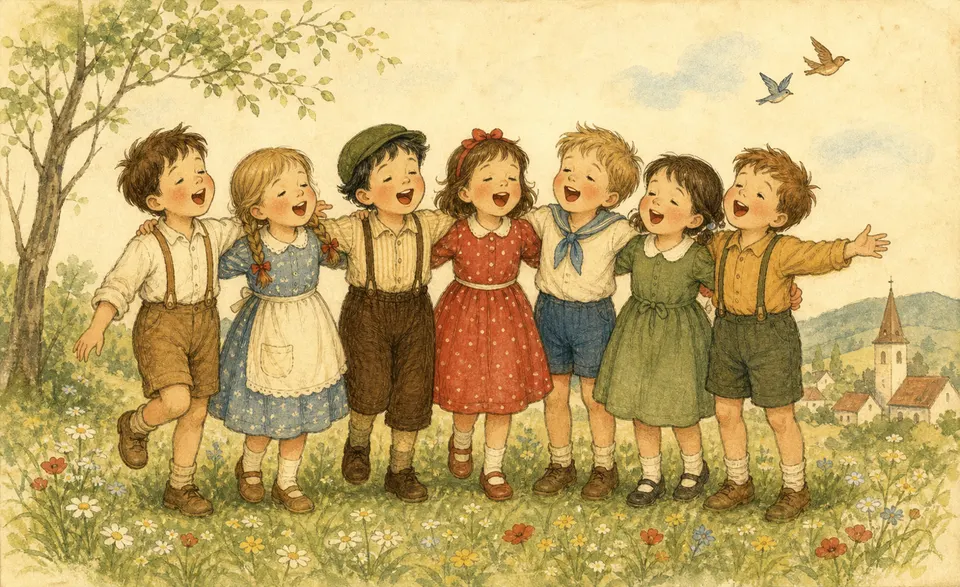
This is barely more than a warm feeling set to a tune, and that is exactly its charm. It simply declares, again and again, that “we like each other, truly we do”, then answers itself with a cheerful shrug of a question — why wouldn’t we like each other? — before landing on its happy reason: because we are all young. There is no story to follow, only a mood to share.
Its repetition is the point. A song like this is made for singing together — a whole group of children able to join in at once, the words easy, the feeling plain — so that the act of singing it becomes the very togetherness it describes. We cannot say who wrote it: the source we cite names no author and records only a performance by Ansambel bratov Avsenik. What is certain is that it does one simple, valuable thing very well — it lets a roomful of children say, in the nicest possible way, that they are glad to be with one another.
Common questions
- What is "Mi se imamo radi" about?
- Simple togetherness. It says, over and over, that "we like each other, truly we do" — and then asks the obvious happy question: why wouldn't we like each other? — because, after all, we're all young. It is less a story than a warm feeling put to a repeating tune.
- When is "Mi se imamo radi" sung?
- As a group sing-along, when a bunch of children (or friends) want to celebrate being together. Its repetition makes it easy to join, and its whole point is the shared good feeling of singing it as one.
- Who wrote "Mi se imamo radi"?
- We do not know. The source we cite names no author at all — it documents only a recording by Ansambel bratov Avsenik — so we make no claim about who wrote the words or the tune.