Lyrics
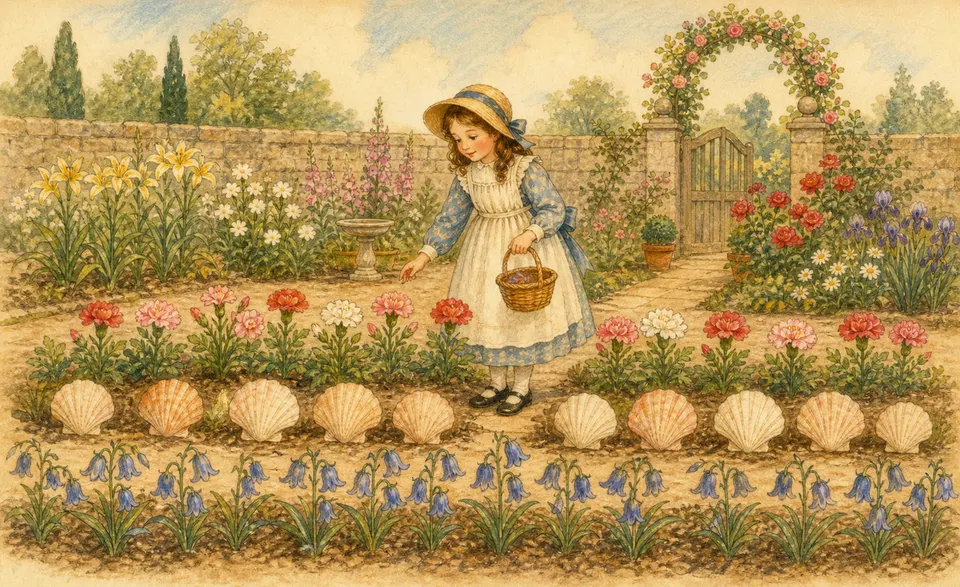
Mary, Mary, quite contrary, How does your garden grow? With silver bells and cockle shells, And pretty maids all in a row.
#Mary, Mary, Quite Contrary at a glance
- Country of origin
- 🇬🇧 United Kingdom
- Sung in
- English
- Words by
- Traditional
- First known
- 1745
- Best for ages
- 2–7
- Mood
- playful, traditional
- Last updated
- 27 August 2026
Meaning and origin
This is a rhyme that sounds as though it means something. It asks a question — how does your garden grow? — and answers it with a strange, pretty inventory of silver bells, cockle shells and maids in a row, all addressed to a girl who is “quite contrary”. That riddling quality has tempted people for centuries to read it as a code.
The two favourite keys are Tudor queens. One reading makes Mary the Catholic queen Mary I, her “garden” a barren reign and the “pretty maids” a grim pun on executions; another makes her Mary, Queen of Scots, with the maids as her famous ladies-in-waiting. Both are ingenious, and both are unsupported — there is no proof the rhyme even existed before the 1700s, and these interpretations were laid over it much later.
The plainer truth is that it is a piece of lovely nonsense, first printed in 1745. A contrary girl, an impossible garden, and a tune — and, as so often, the meaning people most want to find is the one that was never there.
Common questions
- How old is "Mary, Mary, Quite Contrary"?
- The earliest known version was published in 1745, in "Tommy Thumb's Pretty Song Book". There is no proof the rhyme existed before the eighteenth century.
- Is it secretly about Mary I or Mary, Queen of Scots?
- Those are the two most popular theories — reading the "garden", the "silver bells" and the "pretty maids" as coded references to a Tudor queen's reign, religion or ladies-in-waiting. They make a good story, but they are guesswork with no supporting evidence, and were attached to the rhyme long after it was written.
- So what does "Mary, Mary, Quite Contrary" really mean?
- Most likely nothing hidden at all. It is a little riddling verse about a contrary girl and an oddly-planted garden of bells and shells — the kind of pretty nonsense nursery rhymes are full of.