Lyrics
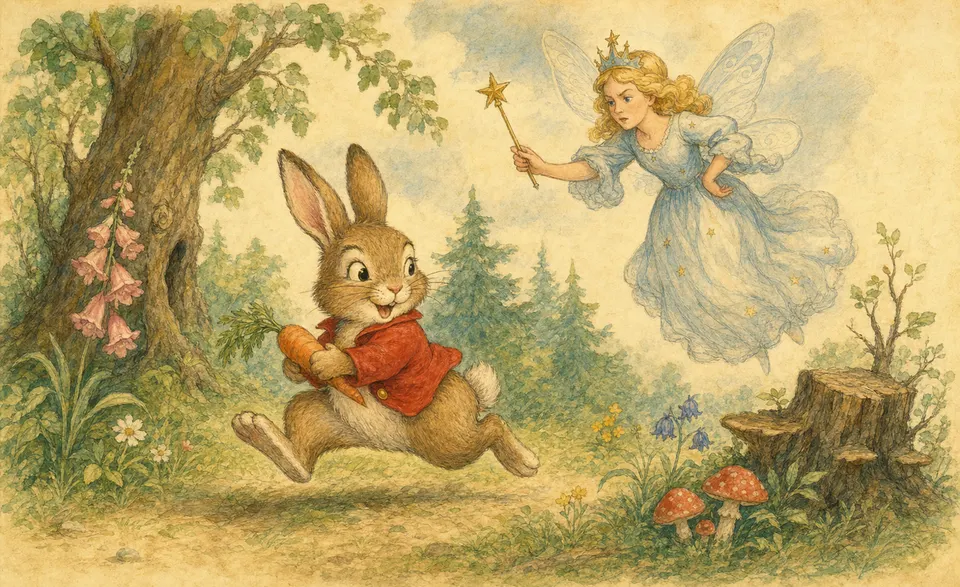
Little Bunny Foo Foo, Hopping through the forest, Scooping up the field mice, And bopping 'em on the head.
#And down came the good fairy and she said: "Little Bunny Foo Foo, I don't want to see you Scooping up the field mice And bopping 'em on the head. I'll give you three chances, And if you don't behave I'll turn you into a goon!"
#The next day same as before, except: two chances... Then: one chance...
#Last verse: "Little Bunny Foo Foo, I gave you three chances, POOF! Now you're a goon!"
#Little Bunny Foo Foo at a glance
- Country of origin
- 🌐 Unknown
- Sung in
- English
- Words by
- Traditional
- First known
- modern; earliest attestations 1970
- Best for ages
- 2–7
- Mood
- playful, traditional
- Last updated
- 27 August 2026
How to sing it
- Hop one hand along like the bunny, and "bop" your other fist gently on each "bopping 'em on the head".
- Wag a finger as the good fairy, counting down the three chances on your fingers.
- On the last "POOF!", throw your hands up to turn the bunny into a goon.
Meaning and origin
This is really a little morality play with actions. Bunny Foo Foo hops through the forest doing something he shouldn’t — scooping up the field mice and bopping them on the head — and a good fairy keeps swooping down to warn him off, offering three chances. He wastes every one, so at last she makes good on her threat and turns him, POOF, into a “goon”. The classic ending delivers the groan-worthy pun the whole thing is built toward: hare today, goon tomorrow.
For all its playground familiarity, it is a modern song, and nobody knows where it came from. The linguist Neal Whitman, who went looking, found nothing earlier than 1970: that year it turns up in Beverly Cleary’s novel Runaway Ralph, where a boy at summer camp sings “Little Rabbit Fru-Fru”, and in The New Yorker, which mentions “little Bunny Phoo Phoo” as a character in a children’s story. Both are American publications, and people remember singing it in the 1960s, but that is as far as the trail goes. There is no ancient pedigree, despite a much-repeated online claim that it turns up in Chaucer or Shakespeare: that began as a joke on the newsgroup alt.folklore.urban in 1997, where fake “early” versions were written into famous texts. Its melody, on the other hand, is genuinely old: the verses are chanted to the tune of the French-Canadian song “Alouette”. Between the hopping, the bopping, the finger-wagging fairy and the final transformation, it gives children a small, satisfying lesson — that bullying the smaller creatures does not, in the end, go unpunished.
Common questions
- What happens in "Little Bunny Foo Foo"?
- A misbehaving rabbit hops through the forest, scooping up field mice and "bopping 'em on the head". A good fairy appears and warns him to stop, giving three chances; he ignores every one, so on the last she turns him into a "goon". It is a comic little cautionary tale — with the well-known moral, "hare today, goon tomorrow".
- What tune is "Little Bunny Foo Foo" sung to?
- To the melody of the French-Canadian song "Alouette" — the same tune shape heard in "Down by the Station". It is spoken-sung, with the verses acted out.
- How old is "Little Bunny Foo Foo", and is it really centuries old?
- No. The linguist Neal Whitman, who traced the song's history, found that the earliest attestations are two from 1970 — Beverly Cleary's novel "Runaway Ralph" and an article in "The New Yorker" — though people recall singing it in the 1960s. The claim that it appears in Chaucer or Shakespeare comes from a tongue-in-cheek exchange on the newsgroup alt.folklore.urban in 1997, in which fake "early" versions were written into famous texts. Where the song actually came from is not known.