Lyrics
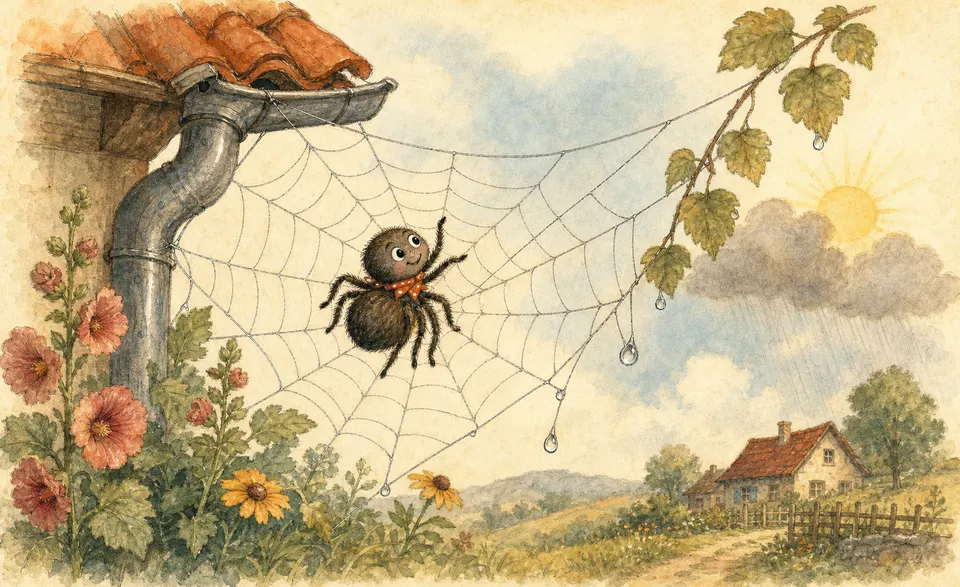
The itsy bitsy spider climbed up the water spout. Down came the rain and washed the spider out. Out came the sun and dried up all the rain, And the itsy bitsy spider climbed up the spout again.
#Itsy Bitsy Spider at a glance
- Country of origin
- 🌐 Unknown
- Sung in
- English
- Words by
- Traditional
- First known
- 1909 (student newspaper); 1910 (as the “Spider Song”)
- Best for ages
- 2–7
- Mood
- dancing, playful
- Last updated
- 27 August 2026
How to sing it
- Touch the thumb of one hand to the index finger of the other, then twist and swap them over and over to make the spider "climb" upward.
- Wiggle your fingers while lowering both hands to show the rain coming down.
- Sweep your arms out wide to wash the spider away.
- Raise your arms in a big circle overhead for the sun, then start the climbing motion again for the last line.
Meaning and origin
Almost every English-speaking child learns this song with their hands before they can say all the words, and that is rather the point of it: it is a fingerplay, a rhyme built to be acted out. The spider climbs, the rain washes it away, the sun comes out, and the spider — undeterred — starts back up the spout. It is a tiny lesson in trying again, delivered entirely through the fingers.
For such a familiar rhyme, its written history is surprisingly short, and where it came from before that is simply not known. The earliest known printing is from 1909, in The Purple and White, the student newspaper of Millsaps College in Mississippi; in 1910 it appeared in Arthur Walbridge North’s Camp and Camino in Lower California as the “Spider Song”. A version turned up again in 1912, and it was only around 1948 — in Western Folklore and in Ruth Crawford Seeger’s American Folk Songs for Children — that the “itsy bitsy” wording most people know became fixed as a nursery rhyme. No author was ever attached to it, and the early printings are American, but that is as far as the record goes.
The song travels under two names. In the United States the spider is “itsy bitsy”; in the United Kingdom and Australia it is “incy wincy”. The words differ but mean the same thing — very small — so a child from London and a child from Los Angeles are singing the same rhyme, whichever spider they name.
Common questions
- When was "Itsy Bitsy Spider" first written down?
- The earliest known printing is from 1909, in "The Purple and White", the student newspaper of Millsaps College in Mississippi. In 1910 it appeared in Arthur Walbridge North's book "Camp and Camino in Lower California", where it is called the "Spider Song". A variant was recorded in 1912, and the familiar "itsy bitsy" version became established as a children's rhyme around 1948. Where the rhyme itself came from is unknown.
- Why is it called "Incy Wincy Spider" in some countries?
- "Itsy Bitsy Spider" and "Incy Wincy Spider" are the same rhyme under two names; "itsy bitsy" and "incy wincy" both simply mean very small. "Incy Wincy Spider" is the usual name in the United Kingdom and Australia, while "Itsy Bitsy Spider" is more common in the United States.
- Who wrote "Itsy Bitsy Spider"?
- No author is known. Like most nursery rhymes it is traditional — it was passed around and printed in several slightly different forms in the early twentieth century before settling into the version sung today.
- What are the hand actions for "Itsy Bitsy Spider"?
- The spider climbs when you touch thumb to opposite forefinger and twist your hands upward; wiggling fingers moving downward are the rain; arms sweeping wide wash the spider out; and a big circle of the arms is the sun that dries the rain before the spider climbs again.