Lyrics
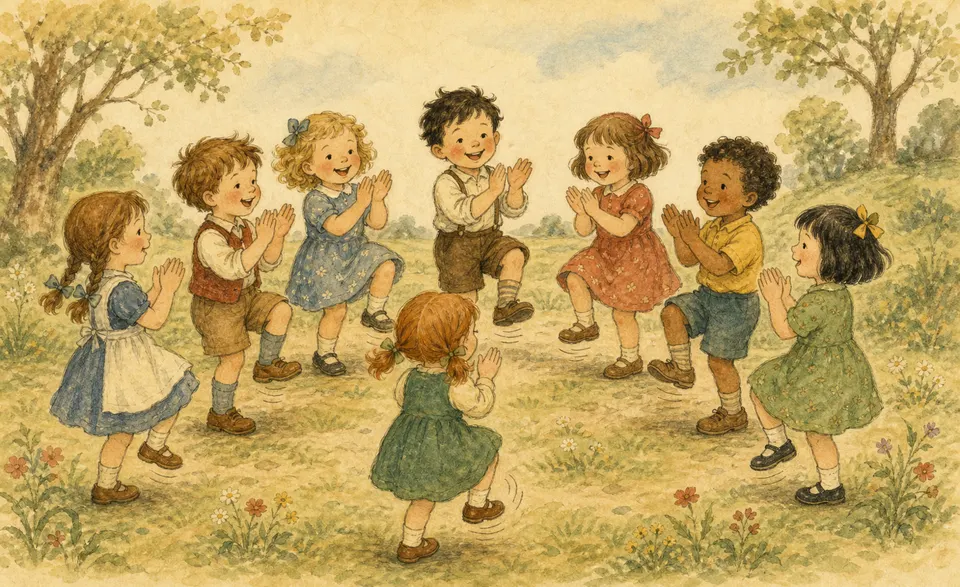
If you're happy and you know it, clap your hands! (clap clap) If you're happy and you know it, clap your hands! (clap clap) If you're happy and you know it, then your face will surely show it. If you're happy and you know it, clap your hands! (clap clap)
#If You're Happy and You Know It at a glance
- Country of origin
- 🇺🇸 United States
- Sung in
- English
- Words by
- Traditional
- First known
- in print by 1957
- Best for ages
- 2–7
- Mood
- dancing, playful
- Last updated
- 27 August 2026
How to sing it
- Clap twice in the gaps, exactly where the song leaves room for them.
- Change the action each verse — stamp your feet, shout "hurray!", nod your head.
- For a last verse, string all the actions together: clap your hands, stamp your feet, and shout hurray!
Meaning and origin
This is a song that will not let a child sit still. It names a feeling and then demands you prove it — clap your hands, stamp your feet, shout hurray — filling every pause with an action, so a whole roomful of children is busy and grinning within a verse or two. Its cheerful logic is that happiness is something you do, not just something you feel.
Its history is more recent and less certain than the old nursery rhymes. It is in print by 1957, in a book of “constructive recreational activities” for children, and appears again in a 1966 nursing-home manual and a 1967 book of drama projects for disabled children; in 1971 the publisher Jonico Music filed for copyright naming Joe Raposo — the composer behind much of the music of Sesame Street — though exactly how far back the song itself goes is unclear, and it is generally described as traditional.
Part of its appeal is that it can grow without limit. Any action fits the frame, so the verses can pile up — clapping, then stamping, then nodding, then all of them at once in a breathless finale — which is why it has been carried into other languages, Japanese among them, and happily muddled by children far from where it began.
Common questions
- Where does "If You're Happy and You Know It" come from?
- Its exact origin is uncertain. It appears in a 1957 volume of "constructive recreational activities" for children, a 1966 nursing-home manual and a 1967 book of drama projects for disabled children, and in 1971 the music publisher Jonico Music filed for copyright crediting the song to Joe Raposo, the composer known for much of the music on "Sesame Street". Wikipedia nonetheless describes it as a traditional American children's song, and this page credits it as traditional.
- How does "If You're Happy and You Know It" work?
- It is an action song: each verse names a feeling and a way to show it — clap your hands, stamp your feet, shout "hurray" — and everyone does the action in the pauses. New verses just add new actions, and the fun is in doing them together and in time.
- Is "If You're Happy and You Know It" sung in other countries?
- Yes. It has been adapted into other languages; the Japanese version, popularised by the singer Kyu Sakamoto, even changes the melody slightly to fit the new words.