Lyrics
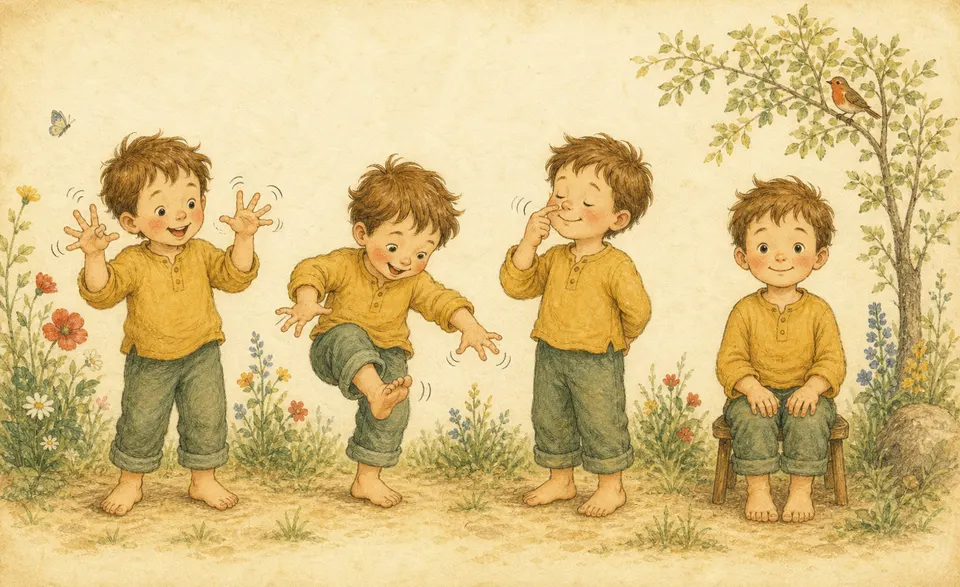
I wiggle my fingers, I wiggle my toes, I wiggle my shoulders, I wiggle my nose.
#Now no more wiggles are left in me So I will be still as still can be.
#I Wiggle at a glance
- Country of origin
- 🌐 Unknown
- Sung in
- English
- Words by
- Traditional
- First known
- author, date and country not documented in the sources consulted
- Best for ages
- 2–7
- Mood
- playful, traditional
- Last updated
- 27 August 2026
How to sing it
- Wiggle each part as it's named — fingers, toes, shoulders, nose.
- Make the wiggling big and giggly on the first verse.
- On "still as still can be", freeze completely — the quieter, the better.
Meaning and origin
This tiny rhyme is a clever piece of crowd-control disguised as a game. It invites children to wiggle everything — fingers, toes, shoulders, nose — as much as they like, and then, having got all that fidgety energy out, to declare now no more wiggles are left in me and sit as still as still can be. It uses movement to reach stillness, which is far easier for a small child than simply being told to sit quietly.
That is exactly why teachers reach for it before story time or any calm activity: a good hard wiggle followed by a sudden freeze settles a restless group better than any instruction. It has no known author — the parents’ booklet it is taken from says nothing about where it came from, so this page does not guess — but its little trick of ending in silence has made it one of the most useful few lines in any circle-time repertoire.
Common questions
- What is "I Wiggle" for?
- Getting the wiggles out. The child wiggles fingers, toes, shoulders and nose, and then — the whole point — announces that "no more wiggles are left in me" and sits perfectly still. It is a calming-down rhyme that uses movement to arrive at stillness.
- When is "I Wiggle" used?
- Usually to settle a restless group. By letting children wiggle hard first and then freeze, it channels fidgety energy into a game and ends with everyone quiet and ready to listen.
- Who wrote "I Wiggle"?
- No author is recorded. The source used here, a parents' booklet of songs and finger plays from a Minnesota school district's early-childhood programme, prints it with no author, date or origin, so this page leaves its country unknown.