Lyrics
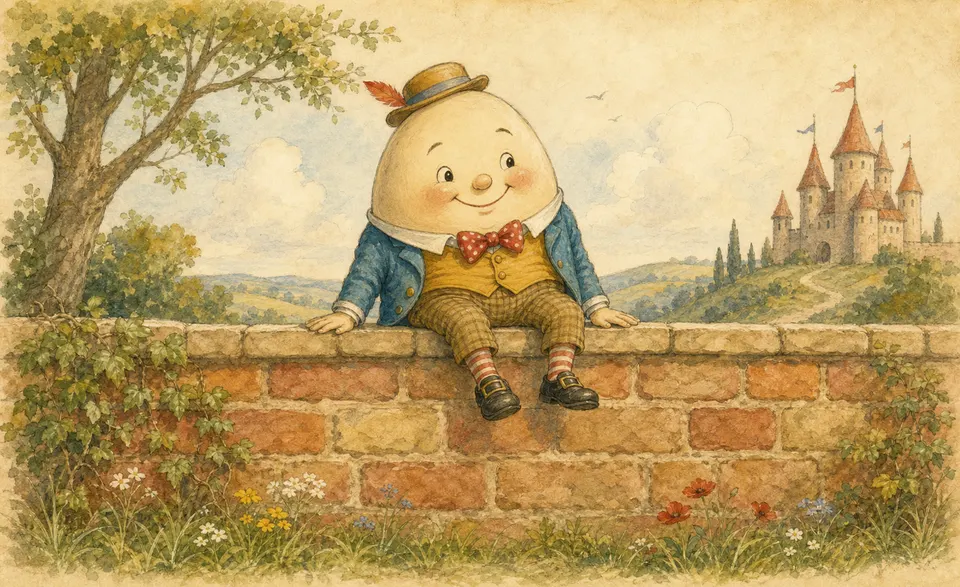
Humpty Dumpty sat on a wall, Humpty Dumpty had a great fall. All the king's horses and all the king's men Couldn't put Humpty together again.
#Humpty Dumpty at a glance
- Country of origin
- 🇬🇧 United Kingdom
- Sung in
- English
- Words by
- Traditional
- First known
- 1797
- Best for ages
- 2–7
- Mood
- playful, traditional
- Last updated
- 25 July 2026
Meaning and origin
The strangest thing about Humpty Dumpty is the thing everyone knows: that he is an egg. The rhyme never says it. Four short lines describe someone who sits on a wall, falls, and cannot be put back together, and nowhere is an egg mentioned — yet no child pictures anything else.
The reason is that the verse was almost certainly a riddle before it was a rhyme. What sits on a wall, and once it falls can never be mended? An egg. By 1843 it was being posed to children exactly that way, with “an egg” as the answer, and the picture stuck so firmly that the solution became the character. The rhyme itself first appears in print in 1797.
Later ages could not leave so blank a canvas alone. Humpty has been explained as King Richard III, as a “tortoise” siege engine at Gloucester in 1643, and as a cannon toppled from the walls of Colchester in 1648 — none of it supported by evidence. The version most people carry, though, comes from a storybook: Lewis Carroll’s Through the Looking-Glass (1871), where Humpty is a talking egg on a wall, easily offended, and quite sure he will not fall.
Common questions
- Is Humpty Dumpty an egg?
- The rhyme never says so. Humpty Dumpty is almost always drawn as an egg, and that is because the verse was probably a riddle — "what, once broken, cannot be mended?" — whose answer is an egg. By 1843 it was already being told to children as a riddle with that solution.
- How old is the rhyme?
- It first appears in print in 1797, in Samuel Arnold's "Juvenile Amusements", though as a spoken riddle it is likely older.
- Did Humpty Dumpty represent a king or a cannon?
- Several theories say so — that Humpty was King Richard III (1930), a siege engine at Gloucester in 1643, or a cannon at the siege of Colchester in 1648. None has real historical evidence; they are later guesses layered onto what was first simply a riddle.
- Where does the egg who talks to Alice come from?
- From Lewis Carroll. In "Through the Looking-Glass" (1871) Carroll turned Humpty into a talking egg who sits on a wall and is annoyed when Alice says he looks "exactly like an egg" — the image that fixed him as an egg in everyone's imagination.