LyricsHalliwell, 1849
Here we go round the mulberry-bush, —The mulberry-bush, the mulberry-bush: Here we go round the mulberry-bush On a sunshiny morning.
#LyricsExpanded hand-action version (after Nursie’s Little Rhyme Book, undated)
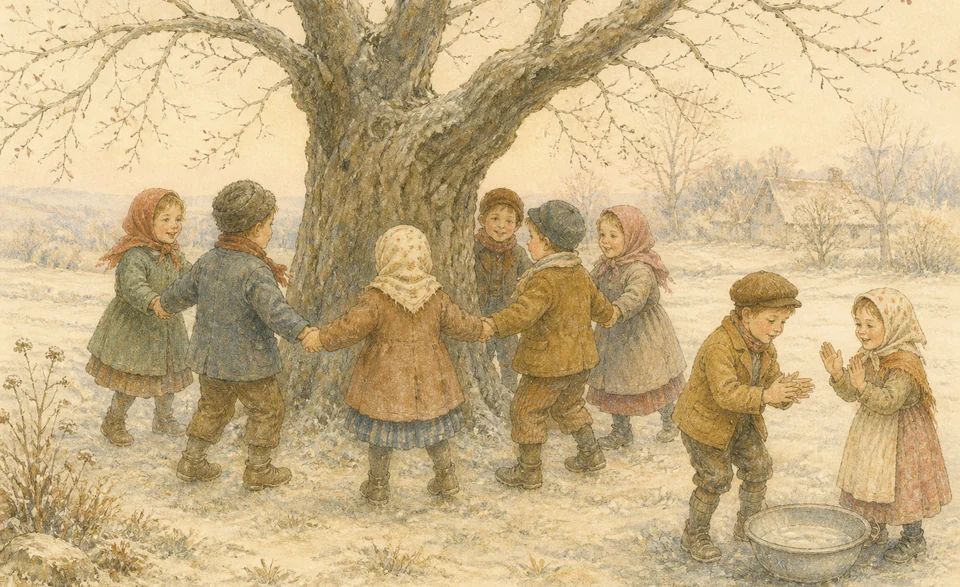
Here we go round the mulberry bush, The mulberry bush, the mulberry bush; Here we go round the mulberry bush, On a cold and frosty morning. This is the way we wash our hands, We wash our hands, we wash our hands; This is the way we wash our hands, On a cold and frosty morning. This is the way we dry our hands, We dry our hands, we dry our hands; This is the way we dry our hands, On a cold and frosty morning. This is the way we clap our hands, We clap our hands, we clap our hands; This is the way we clap our hands, On a cold and frosty morning. This is the way we warm our hands, We warm our hands, we warm our hands; This is the way we warm our hands, On a cold and frosty morning.
#LyricsSupplied warming-up classroom version
Here we go round the mulberry bush, The mulberry bush, The mulberry bush; Here we go round the mulberry bush, On a cold and frosty morning. We rub our hands to keep us warm, Keep us warm, Keep us warm; We rub our hands to keep us warm, On a cold and frosty morning. We stamp up and down to keep us warm, Keep us warm, Keep us warm; We stamp up and down to keep us warm, On a cold and frosty morning. Here we go round the mulberry bush, The mulberry bush, The mulberry bush; Here we go round the mulberry bush, On a cold and frosty morning.
#Here We Go Round the Mulberry Bush at a glance
- Country of origin
- 🇬🇧 United Kingdom
- Sung in
- English
- Words by
- Traditional
- First known
- 1849 (Halliwell, Popular Rhymes and Nursery Tales); c. 1858 (first printing with music, as “Morning Song”)
- Best for ages
- 2–7
- Mood
- dancing, playful, traditional
- Last updated
- 27 August 2026
How to sing it
- Hold hands and walk around in a circle during the opening stanza.
- Release hands for the later verses and mime washing, drying, clapping, and warming them.
Meaning and origin
This is both a circle song and an action sequence. The opening sends the group around an imagined mulberry bush; each later verse stops the circle for a familiar movement — washing, drying, clapping, warming the hands — before the ring closes and goes round again.
The game is older than any printed mulberry bush. James Orchard Halliwell recorded it in 1849 in Popular Rhymes and Nursery Tales, where the children go round the bush “on a sunshiny morning” and the motion-cries are washing and drying clothes, making and mending shoes, and the way the gentlemen and the ladies walk; he adds that a “bramble-bush” version was sung the same way on a “cold frosty morning”. The Morgan Library catalogues the first printing of the words and music together in Asa Fitz’s The Exercise Song Book (Boston, c. 1858), as a “Morning Song” that begins with washing the face and ends “so early in the morning” — the tune is there, but the mulberry bush is not. Dorothy Canfield Fisher’s What Shall We Do Now? (1907) prints the opening as it is sung today.
The tune itself is older still: it is the one the dancer Nancy Dawson made famous in The Beggar’s Opera in mid-eighteenth-century London, and it also carries “Nuts in May”. A local tradition that the song began with women prisoners exercising round a mulberry tree at Wakefield prison is told by a local historian; nothing in the earlier record confirms it.
The hand-action text here follows Nursie’s Little Rhyme Book, an undated picture book from the London publisher Augener, illustrated by H. Willebeek le Mair, which gives the full opening and abbreviates its repeated action stanzas with “etc.”. Those repetitions are expanded editorially and labelled as such, so the page can be sung straight through; the shorter warming-up sequence in the last panel is a supplied classroom version, not a historical one.
Common questions
- How old is “Here We Go Round the Mulberry Bush”?
- James Orchard Halliwell printed it as a children's game in 1849, in Popular Rhymes and Nursery Tales, with the closing line “On a sunshiny morning” and the note that a “bramble-bush” game was sung the same way on a “cold frosty morning”. The Morgan Library catalogues the first printing of words and music together as “Morning Song” in Asa Fitz's The Exercise Song Book (Boston, c. 1858) — a version that begins “This is the way we wash our face” and never mentions a mulberry bush. Dorothy Canfield Fisher's What Shall We Do Now? (1907) prints the familiar mulberry-bush opening.
- Where does the tune come from?
- It is the melody that the dancer Nancy Dawson made famous in The Beggar's Opera in mid-18th-century London; the same tune serves “Nuts in May” and “Lazy Mary, Will You Get Up”.
- Why are there different action verses?
- The song is a flexible action game. Halliwell's 1849 “motion-cries” were washing and drying clothes, making and mending shoes, and the way the gentlemen and the ladies walk; Nursie's Little Rhyme Book, an undated Augener picture book illustrated by H. Willebeek le Mair, lists washing, drying, clapping and warming the hands; other collections use weekday chores.
- Why are there three text panels?
- The first is Halliwell's 1849 text. The second expands the washing, drying, clapping and warming actions that Nursie's Little Rhyme Book abbreviates with “etc.”, so it can be sung straight through. The third preserves a supplied modern classroom sequence with rubbing hands and stamping; the repeated structure makes new routine verses easy to add.
Sources
- J. O. Halliwell, Popular Rhymes and Nursery Tales (1849), Project Gutenberg
- Wikipedia — Here We Go Round the Mulberry Bush
- The Morgan Library & Museum — Asa Fitz, The Exercise Song Book (Boston, c. 1858)
- Dorothy Canfield Fisher, What Shall We Do Now? (1907), Project Gutenberg
- Nursie’s Little Rhyme Book, illustrated by H. Willebeek le Mair (Augener, London; undated), Project Gutenberg
- National Literacy Trust, Words for Life — Here We Go Round the Mulberry Bush