Lyrics
Head, shoulders, knees and toes, knees and toes. Head, shoulders, knees and toes, knees and toes. And eyes and ears and mouth and nose. Head, shoulders, knees and toes, knees and toes.
#Head, Shoulders, Knees and Toes at a glance
- Country of origin
- 🌐 Unknown
- Sung in
- English
- Words by
- Traditional
- First known
- 1912 (The Children's Friend, Salt Lake City)
- Best for ages
- 2–7
- Mood
- dancing, playful, educational
- Last updated
- 27 August 2026
How to sing it
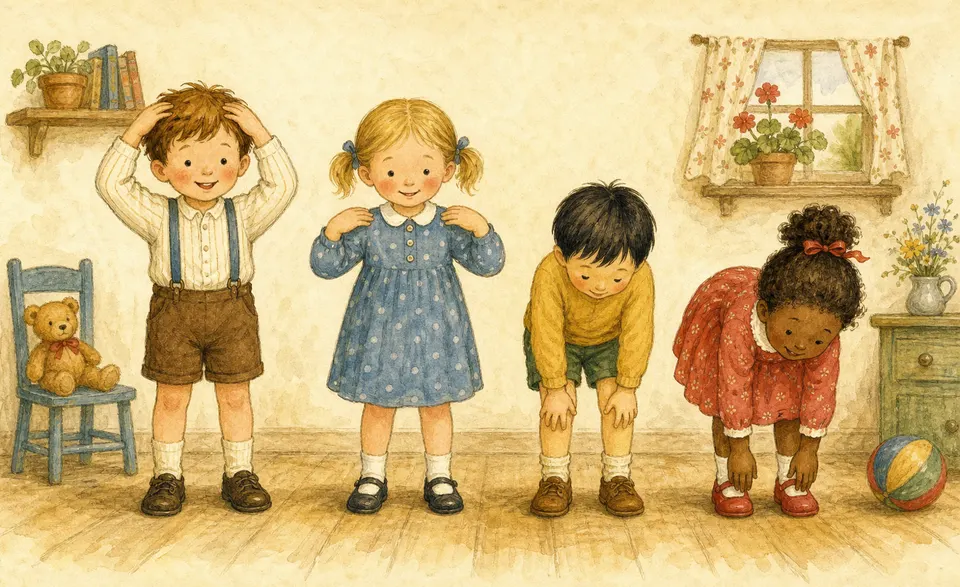
- Touch each part as you name it — head, shoulders, knees, toes, then eyes, ears, mouth and nose.
- Start slowly, then speed up each time round until everyone is in a tangle.
- For a challenge, leave out one word each verse but keep touching the part in silence — then two words, then three.
Meaning and origin
The words of this song are simply a list of body parts, and that is the whole point: it is a song for the hands more than the voice. You touch your head, your shoulders, your knees, your toes, and then race back up to eyes and ears and mouth and nose, faster each time, until the whole room is bending and pointing and getting hopelessly tangled.
It is not one of the ancient rhymes. The earliest record found is from September 1912, in The Children’s Friend, a children’s magazine published in Salt Lake City, and it turns up again in 1921 in a Waterloo, Iowa newspaper. Both are American, but no source consulted says where the song was first made up, and so this page leaves its country blank rather than guess. It does not really have its own tune, either: it borrows one, usually the melody of “There Is a Tavern in the Town”, though it has been sung to “London Bridge Is Falling Down”, “Here We Go Round the Mulberry Bush” and “Frère Jacques” as well. The words were only ever a frame for the actions.
Its best trick is the disappearing-word game. Each time through, you drop one word but keep touching the part in silence; then two words, then three, until you are miming most of the song and singing almost none of it. That is also why it is so useful in a classroom: point, name, repeat, and a child learns the parts of the body without ever feeling taught.
Common questions
- What tune is "Head, Shoulders, Knees and Toes" sung to?
- Most often to the melody of "There Is a Tavern in the Town". It has also been fitted to other tunes — "London Bridge Is Falling Down", "Here We Go Round the Mulberry Bush" and "Frère Jacques" among them — and translations into other languages often use tunes of their own.
- How old is "Head, Shoulders, Knees and Toes", and where is it from?
- It is documented from 1912, in the September issue of "The Children's Friend", a children's magazine published in Salt Lake City, and again in 1921 in a newspaper from Waterloo, Iowa. Both early records are American, but none of the sources consulted says where or by whom the song was made up, so its country of origin is given here as unknown.
- What is the "dropping words" game?
- A favourite way to play it: each time through, you stop singing one of the words but still touch that body part in silence. Verse by verse more words drop out, until you are miming most of the song — and usually laughing.
- Why is "Head, Shoulders, Knees and Toes" used in classrooms?
- Because its words are simply the names of body parts, and children touch each one as they sing it, so the names are learned through movement rather than by rote.