Lyrics
Der vollständige Liedtext von „Guten Morgen Lied“ mit englischer Übersetzung.
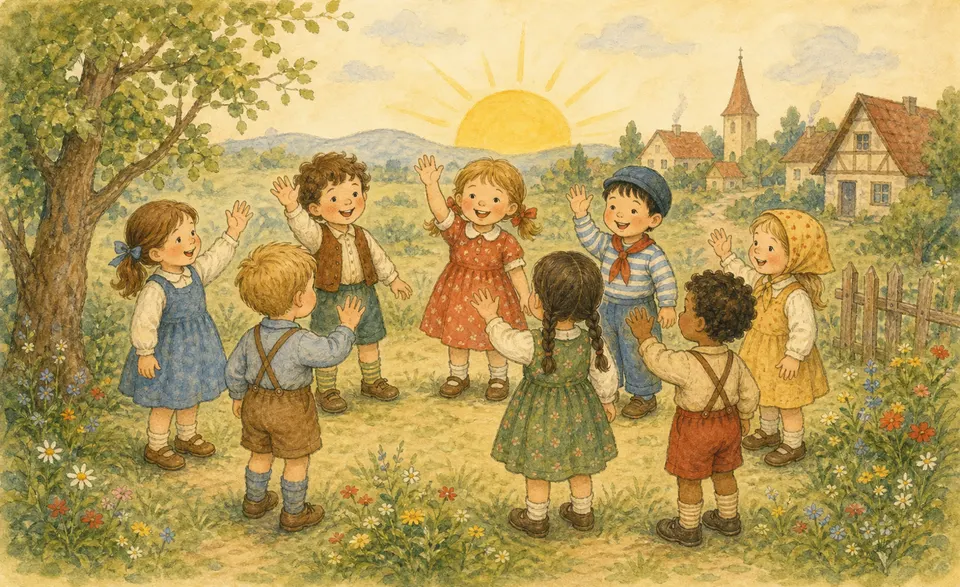
Guten Morgen, guten Morgen, wir winken uns zu. Guten Morgen, guten Morgen, erst ich und dann du.
#Der/Die (Name des Kindes) ist da…
#English translation
Good morning, good morning, we wave to one another. Good morning, good morning, first me and then you. (Child's name) is here…
#Guten Morgen Lied at a glance
- Country of origin
- 🇩🇪 Germany
- Sung in
- German
- Words by
- Traditional
- First known
- traditional kindergarten song; author unknown
- Best for ages
- 2–7
- Mood
- playful, traditional
- Last updated
- 25 July 2026
Meaning and origin
This is a song for the very start of the day, sung in the morning circle of countless German crèches and kindergartens. It could hardly be simpler: everyone sings “good morning” and waves to each other — erst ich und dann du, “first me and then you” — and then the group goes round naming each child in turn, so that every single one is greeted and made to feel present.
There is no known author; it is a traditional group song that drifts a little from place to place, and this is just one common version. Its job is not to be clever but to be shared: it gathers a room of small children into a circle, gives them a gentle ritual to begin with, and makes sure that each of them, by name, is welcomed into the day.
Common questions
- What is the "Guten Morgen Lied" for?
- Starting the day together. It is a morning-circle song: the group sings "good morning" and waves to one another — "first me and then you" — and then names each child in turn ("... ist da", "so-and-so is here"), so everyone is greeted and counted in.
- Who wrote "Guten Morgen Lied"?
- No author is recorded. It is a traditional kindergarten song with many small variations from place to place; this is one common version. Songs like it are passed on among teachers rather than written by a single composer.
- How is "Guten Morgen Lied" sung?
- In a circle, with waving. Everyone waves on "wir winken uns zu" ("we wave to each other"), and the last line is filled in with a child's name so that each one, one by one, is welcomed by the whole group.